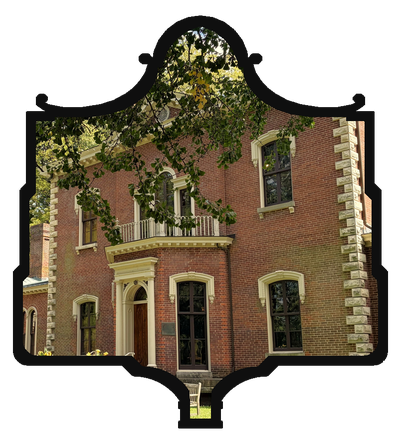
“Election day, Aug. 6, 1855, known as Bloody Monday due to riots led by ‘Know-Nothing’ mobs. This political party was anti-Catholic and nativist. Attacks on German immigrants east of downtown and Irish in the west caused at least 22 deaths, arson, and looting. Catholic Cathedral of the Assumption & St. Martin’s Church were threatened with destruction.”
“This party feared that Catholic immigrants from Germany and Ireland threatened Protestantism and democracy. By 1854, the party claimed a million members nationwide and led Jefferson Co. govt. They split over slavery and by the end of the Civil War they had vanished from politics in Louisville and Jefferson Co. Given by Anc. Ord. Hibernians & German-Amer. Club.”
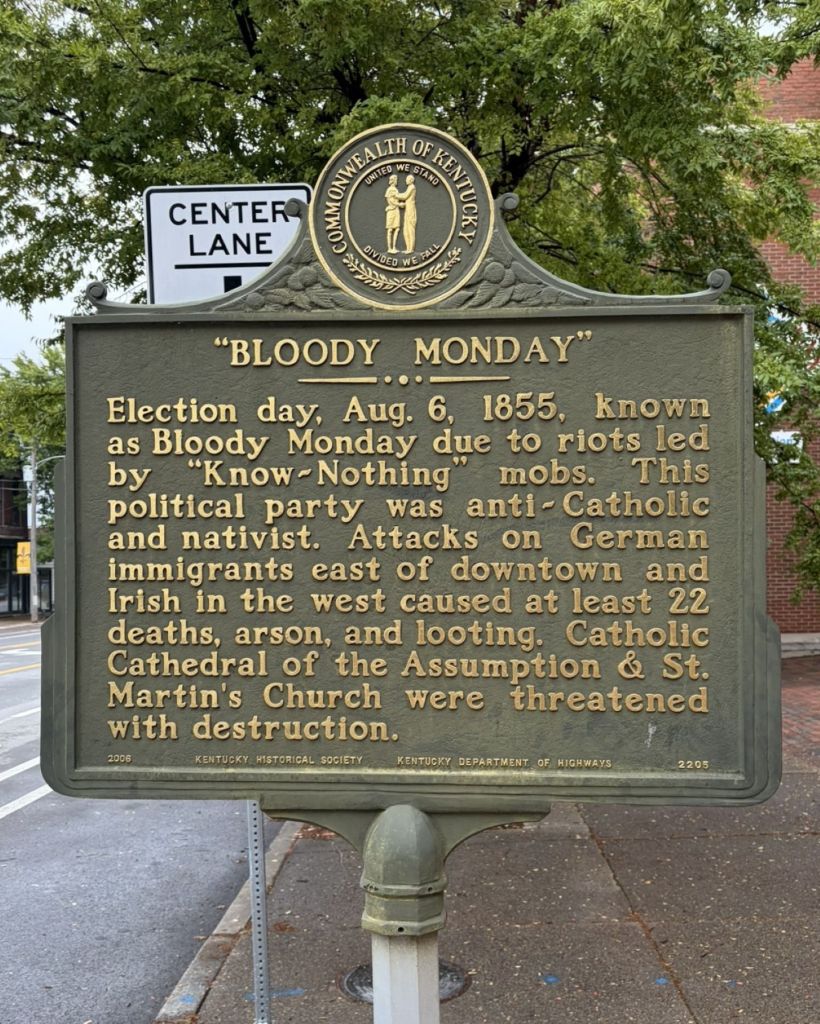
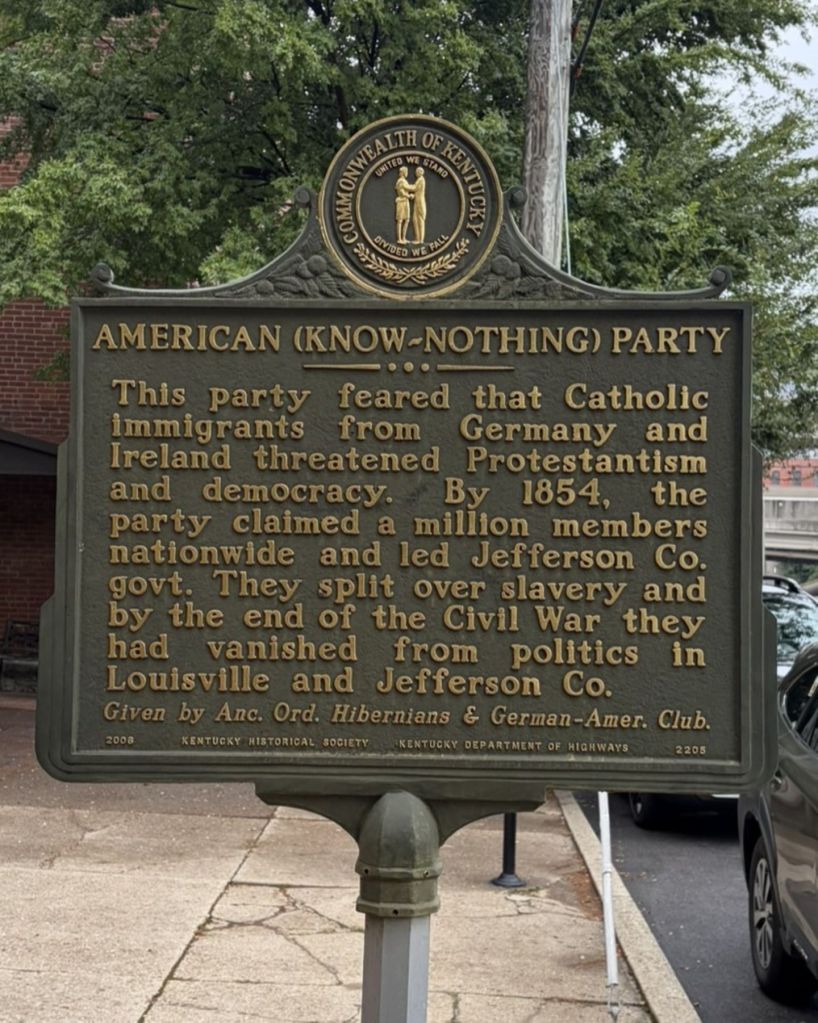
Kentucky Historical Society, Marker No. 2205 — erected 2006
1011 W. Main St., Louisville | 38° 15′ 28″ N, 85° 46′ 01″ W — Directions: MapQuest
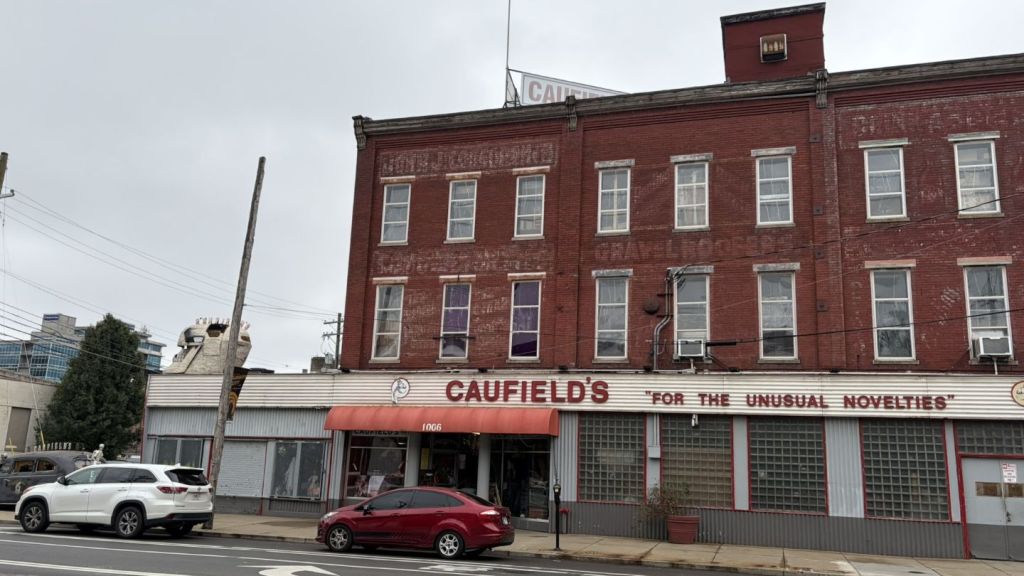
The marker stands at the curb on West Main Street, in front of the Kentucky Lottery’s headquarters, a few blocks west of the bourbon distilleries and museums that draw visitors downtown. Across the street is a costume supply store. Nothing on the block suggests what happened here in August 1855. This stretch of Main between Tenth and Eleventh Streets was lined with frame houses rented mostly to Irish families. By the night of the August 6 election for governor and Congress, those houses were burning, and people trying to escape them were being shot.
The marker covers the riot on one side and the political party behind it on the other. Both panels are accurate in outline. The fuller story is worth telling, along with a few places where the marker’s wording smooths over something more complicated.
A City Divided by Birthplace
Louisville in the early 1850s was one of the fastest-growing cities in the West, and much of that growth came from Europe. Irish families fleeing the famine and Germans leaving the upheavals that followed the revolutions of 1848 arrived by the thousands. Louisville had about 43,000 residents at the 1850 census, and by the time of the riot, roughly a third of the city’s people were immigrants. They settled in distinct neighborhoods, as the marker notes: Germans east of downtown, around Shelby Street and in what is now Butchertown and Phoenix Hill, and the Irish to the west, along the river and Main Street. Most were Catholic, and most of those who could vote voted Democratic.
The “Know-Nothings” grew out of that immense change. The movement began in the early 1850s as a network of secret lodges, formally called the Order of the Star Spangled Banner, whose members were instructed to answer questions about it by saying they knew nothing. As the Whig Party collapsed, the order went public as the American Party and drew many former Whigs. Its program was straightforward: keep Catholics and the foreign-born out of office, and lengthen the waiting period before immigrants could become citizens and vote.
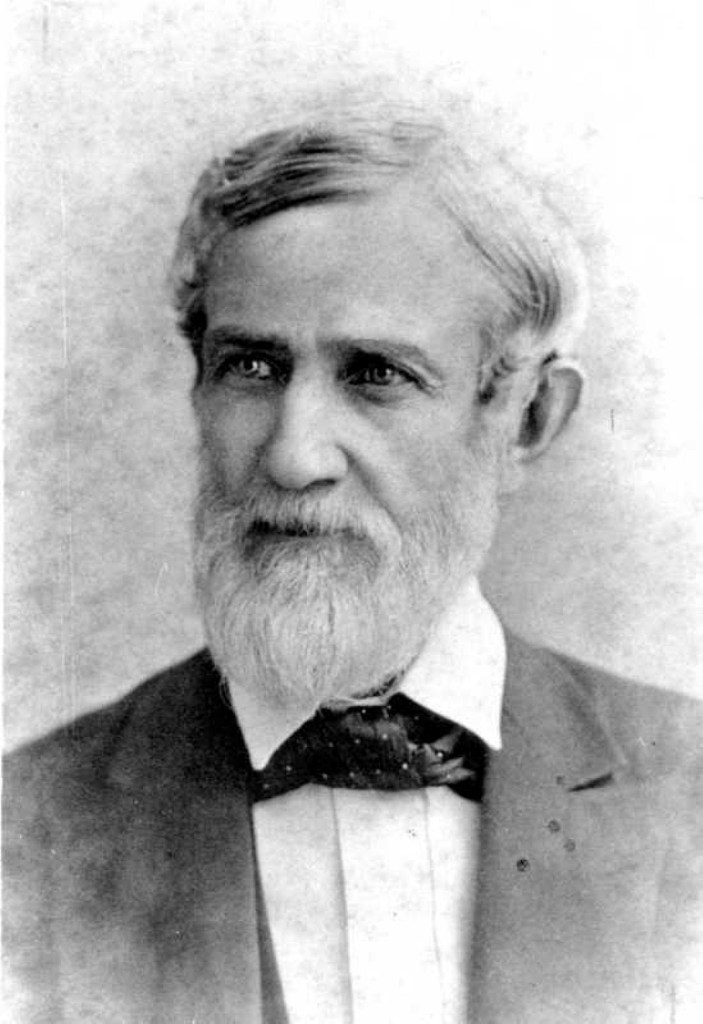
In Louisville, the party moved fast. In April 1855, John Barbee won the mayor’s race on the Know-Nothing ticket, and within weeks the party controlled city government. The outgoing mayor, James Stephens Speed, a convert to Catholicism, had already been pushed aside by a court ruling over the election. Rumors spread that weapons were being stored in Catholic churches, and in the weeks before the August vote, nativist crowds searched at least one of them. They found nothing.
George D. Prentice and the Louisville Journal
Much of the city’s political temperature was set by George D. Prentice (1802–1870), the Connecticut-born editor of the Louisville Journal. Prentice had founded the paper in 1830 to support Henry Clay, and his sharp, satirical pen made it one of the most widely quoted papers in the country. After Clay’s death in 1852 and the collapse of the Whigs, Prentice brought his readers with him into the Know-Nothing camp.

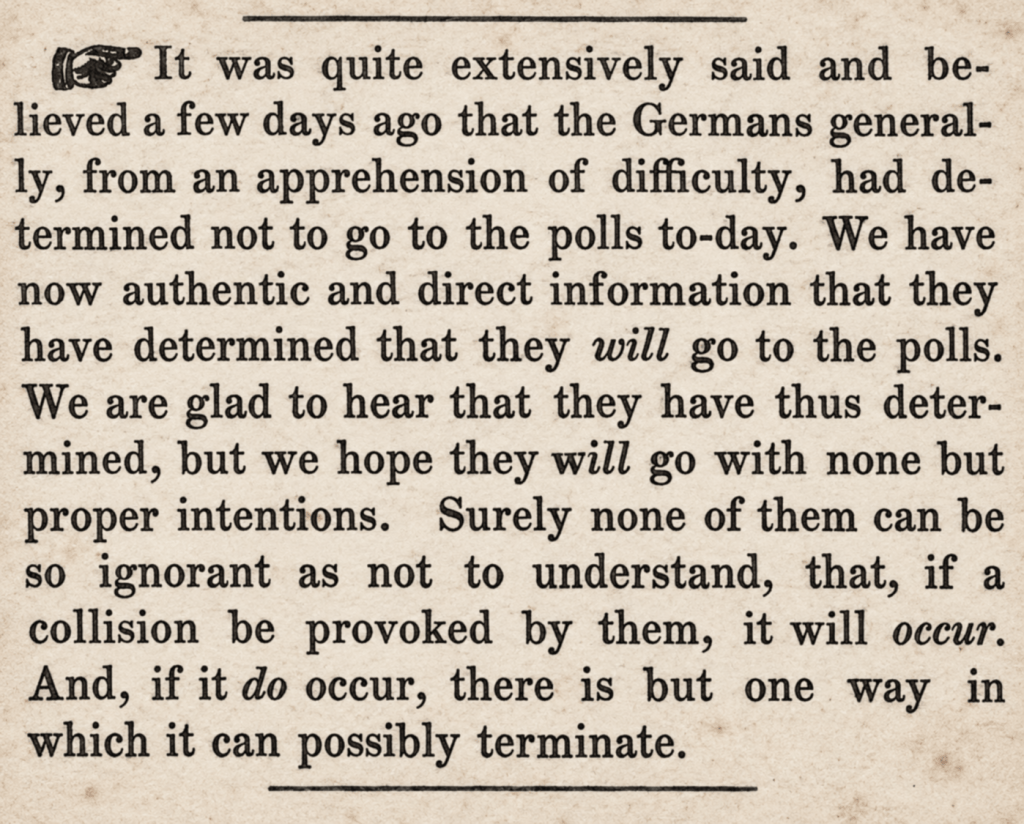
In the days before the election, the Journal called the pope “an inflated Italian despot” and warned of the “overweening and most pestilent influence of the foreign swarms.” On the morning of the vote, the paper ran a column of short rallying items. One told readers to “whip the foreigners as Washington did at Yorktown.” Another read: “Americans, are you all ready? We think we hear you shout ‘Ready!’ Well, fire! and may heaven have mercy on the foe.” On the editorial page, responding to word that German voters meant to go to the polls, the paper warned that “if a collision be provoked by them, it will occur. And, if it do occur, there is but one way in which it can possibly terminate.”
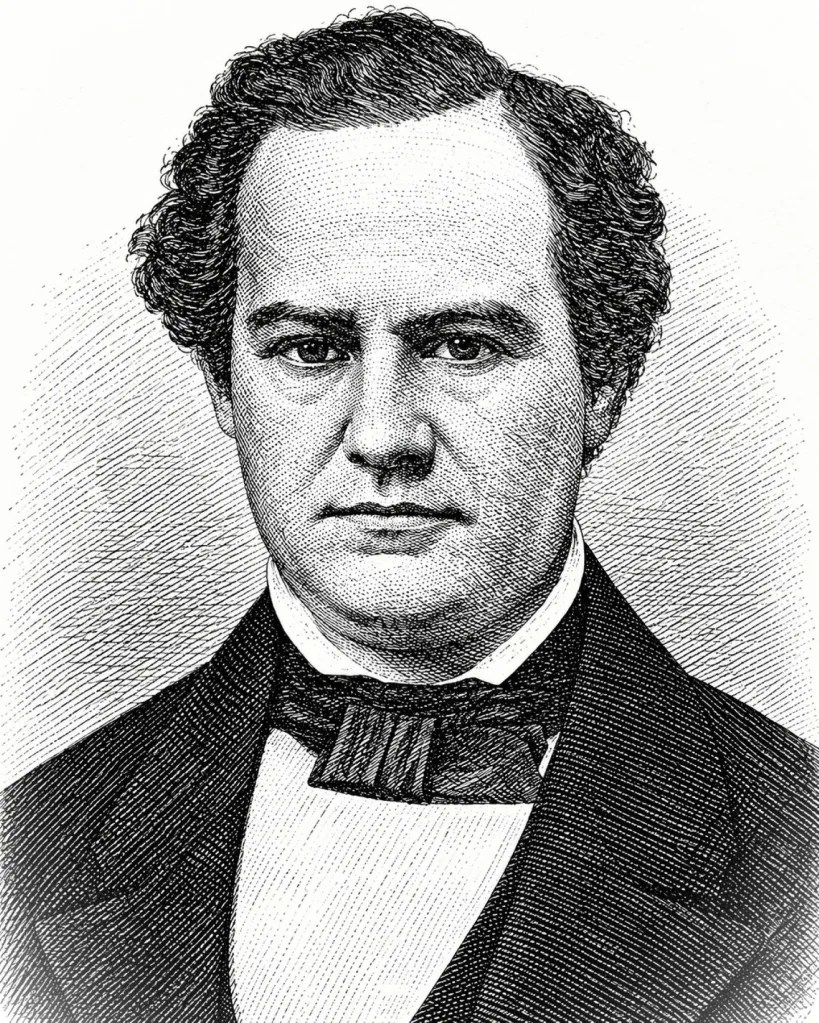
Whether Prentice caused the riot has been argued ever since, and the violence had more than one source. The clearer question is whether he wrote responsibly, and historians who have studied his editorials have generally concluded he did not. Three days after the riot, he wrote that he felt no cause for remorse and blamed the opposition papers. Years later, according to Bishop John Lancaster Spalding, nephew of the Louisville bishop who lived through the riot, he came to regret his part. Louisville’s German-language paper, the Anzeiger, had taken the opposite approach, urging German voters to go early, avoid crowds, and refuse to be provoked.
Election Day, August 6, 1855
The vote that Monday was a state election, for governor, Congress, and the legislature, not a city race. Armed Know-Nothing men took control of polling places early, some of them the night before. Voters who could not show they were with the party were jostled, threatened, or simply kept from reaching the window. In several wards, naturalized citizens with every legal right to vote were turned away, and hundreds of others stayed home rather than risk it.
Fighting started in the morning and spread through the day. In the Sixth Ward, former congressman William Thomasson tried to calm a crowd and was struck from behind and beaten. In the afternoon, a brawl on Shelby Street, in the German section east of downtown, left more than a dozen men shot. Know-Nothing crowds broke into German coffeehouses and looted them. Around four o’clock in the afternoon, an armed mob turned toward St. Martin of Tours, the German Catholic church on Shelby Street. Later, a German brewery on Jefferson Street was set on fire. A German priest, Father Karl Boeswald, was struck by stones as he went to visit a dying parishioner, and died of his injuries.
The mayor’s role is one of the stranger parts of the day. Barbee had asked for special police at the polls, but the city council refused, and on election day his party’s supporters held them. But when the crowd moved on St. Martin’s, Barbee went out in person and talked them back to the First Ward polling place. He is also credited with keeping the mob away from the Cathedral of the Assumption on Fifth Street. Both churches still stand. Bishop Martin John Spalding and a number of Protestant clergy spent the following days urging Catholics not to retaliate.
Quinn’s Row
The worst of the violence happened here. Late in the afternoon, on Main Street near Eleventh, a group of Know-Nothings attacked three Irishmen and knocked one of them down. Irish residents fired from upper windows along the block. At least two men in the crowd, a river worker named Rodes and a man named Graham, were killed. Accounts of the next few minutes are confused and partisan, and it is not possible now to say with certainty who shot whom.
What followed is more clear. After dark, the mob set fire to a row of frame tenements on Main between Tenth and Eleventh, owned by an Irishman named Quinn and known as Quinn’s Row. Twelve buildings burned. Tenants who ran from the flames were shot as they came out, and some of the wounded could not get clear of the fire. Contemporary reports describe at least one man being pushed back into a burning building. The bodies of the dead were later taken to the Jefferson County Courthouse, which the Know-Nothings had used throughout the day as a stronghold and arsenal.
How Many Died?
The marker says “at least 22,” and that wording is careful for a reason. Contemporary counts ranged from 14 to more than 100, and no official inquiry was ever made. Historians today generally put the toll between 19 and 22, most of them Irish and German immigrants. Catholic sources at the time, including Bishop Spalding, believed the number was far higher, more than 100, on the grounds that whole families had died in the fires and were never counted. No one made a complete list. More than 100 homes, shops, and tenements were damaged, looted, or burned across the city, and the ruins on Main Street stood for years.
The Aftermath
The Know-Nothings won. Their candidate for governor, Charles S. Morehead, carried Kentucky by about 4,400 votes, the only governor the party ever elected in the state, and Louisville’s seat in Congress went to the party’s Humphrey Marshall. No one was held to account for the killings. A handful of men were indicted, and none was convicted. The victims were never compensated.
Many immigrants concluded that Louisville was not safe for them. By some estimates, more than 10,000 people left over the next several years, many for St. Louis, Chicago, and Milwaukee, and the departures continued until the Civil War. Some historians have argued that the exodus helped St. Louis and Cincinnati pull ahead of Louisville as regional centers. Others think the effect has been overstated. Either way, a great many families who had chosen Louisville decided to start over somewhere else.
The riot was noticed well beyond Kentucky. Less than three weeks later, on August 24, 1855, Abraham Lincoln wrote to his close friend Joshua Speed, who lived in Louisville (his nephew J.B. Speed is the namesake of the city’s Speed Art Museum), explaining why he could never join the Know-Nothings: “As a nation, we began by declaring that ‘all men are created equal.’ We now practically read it ‘all men are created equal, except negroes.’ When the Know-Nothings get control, it will read ‘all men are created equal, except negroes, and foreigners, and catholics.’”
Reading the Reverse Side
The reverse panel describes the party in a few sentences, and most of it holds up. A few phrases are worth a second look.
“This party feared that Catholic immigrants … threatened Protestantism and democracy” states the Know-Nothings’ own view, and the marker is right to frame it as a fear rather than a fact. It is worth being plain about what happened on this street: the threat to democracy in Louisville on August 6 came from the men who seized the polls and kept citizens from voting.
“By 1854, the party claimed a million members nationwide” is a fair figure. Membership was secret and no reliable count exists, but historians’ estimates for the movement’s peak in 1854 and 1855 are in that range. Only men could join, and about four million votes were cast in the 1856 presidential election, so a million members would have equaled roughly one in four of the men who voted.
“They split over slavery” is correct, and it was the split, more than public revulsion at riots like this one, that ended the party. The break came at the party’s national meetings in 1855 and 1856, and after Millard Fillmore’s distant third-place finish as its presidential candidate in 1856, the American Party was finished as a national force. Northern Know-Nothings largely moved into the new Republican Party, and in Kentucky, most of the party’s voters drifted into opposition coalitions that became the Constitutional Union Party of 1860.
That makes “by the end of the Civil War they had vanished” a generous endpoint. Some local officeholders elected as Know-Nothings stayed in Louisville politics into the late 1850s, but the party itself was gone years before the war ended. By 1865, Louisville had elected Philip Tomppert, a German immigrant, as mayor.
Who Put the Marker Here
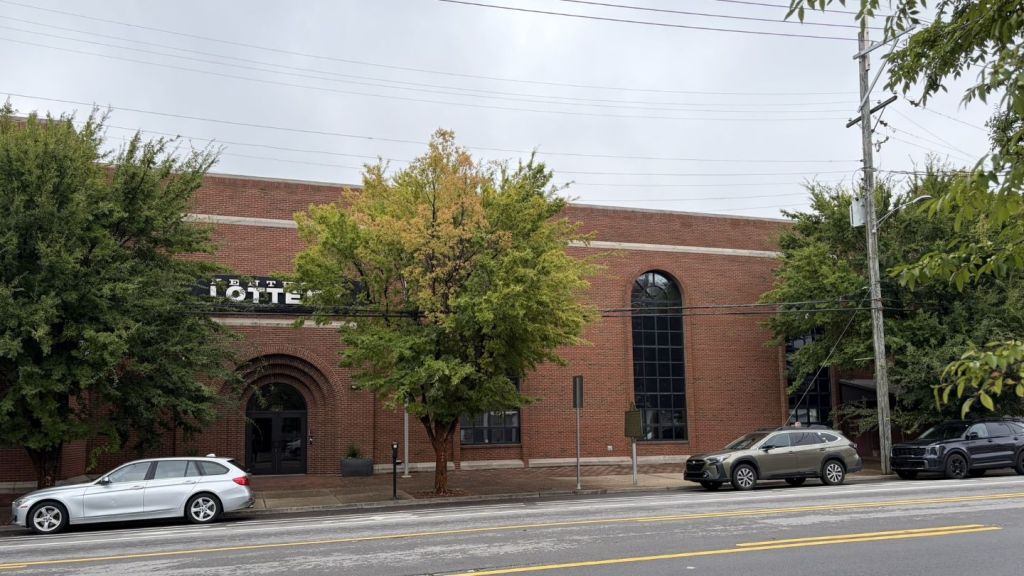
The marker was erected in 2006, a year after the riot’s 150th anniversary, with funding from two groups: the Ancient Order of Hibernians, an Irish Catholic fraternal organization, and Louisville’s German-American Club. Members of both communities have gathered at the site for small commemorations since then. As one organizer of the 150th-anniversary observance put it, “It’s important that Bloody Monday be remembered so that a similar event does not happen again.” The location was chosen with care. Of all the places the violence touched that day, from Shelby Street to the cathedral, this block was where it was worst.
Today, the Cathedral of the Assumption and St. Martin of Tours are both active parishes, and the German and Irish neighborhoods the mobs attacked are part of the city’s identity. Quinn’s Row is gone. The only sign that it was here is the marker in front of the Lottery building.
Sources consulted: Kentucky Historical Society marker database; George H. Yater, “Bloody Monday,” in The Encyclopedia of Louisville (2001); Emmet V. Mittlebeeler, “The Aftermath of Louisville’s Bloody Monday Election Riot of 1855,” Filson Club History Quarterly 66, no. 2 (1992); William G. O’Toole Jr. and Charles E. Aebersold, trans., “Louisville’s Bloody Monday Riots from a German Perspective,” Filson Club History Quarterly 70, no. 4 (1996); Thomas D. Baldwin, “George D. Prentice, the Louisville Anzeiger, and the 1855 ‘Bloody Monday’ Riots,” Filson Club History Quarterly 67, no. 4 (1993); Louisville Daily Journal, August 6, 1855 (Kentucky Digital Newspaper Program, University of Kentucky Libraries); Abraham Lincoln to Joshua F. Speed, August 24, 1855, Collected Works of Abraham Lincoln; Historical Marker Database (hmdb.org); Clio, “‘Bloody Monday’ Riot Site”; Ancient Order of Hibernians, “Louisville’s Bloody Monday” (2018); Irish Echo, “Louisville’s ‘Bloody Monday’ is still remembered and marked” (2017); Wikipedia, “Bloody Monday,” “John Barbee,” “George D. Prentice,” “Charles S. Morehead,” and “Humphrey Marshall (general).”



I’m eager to hear what you think