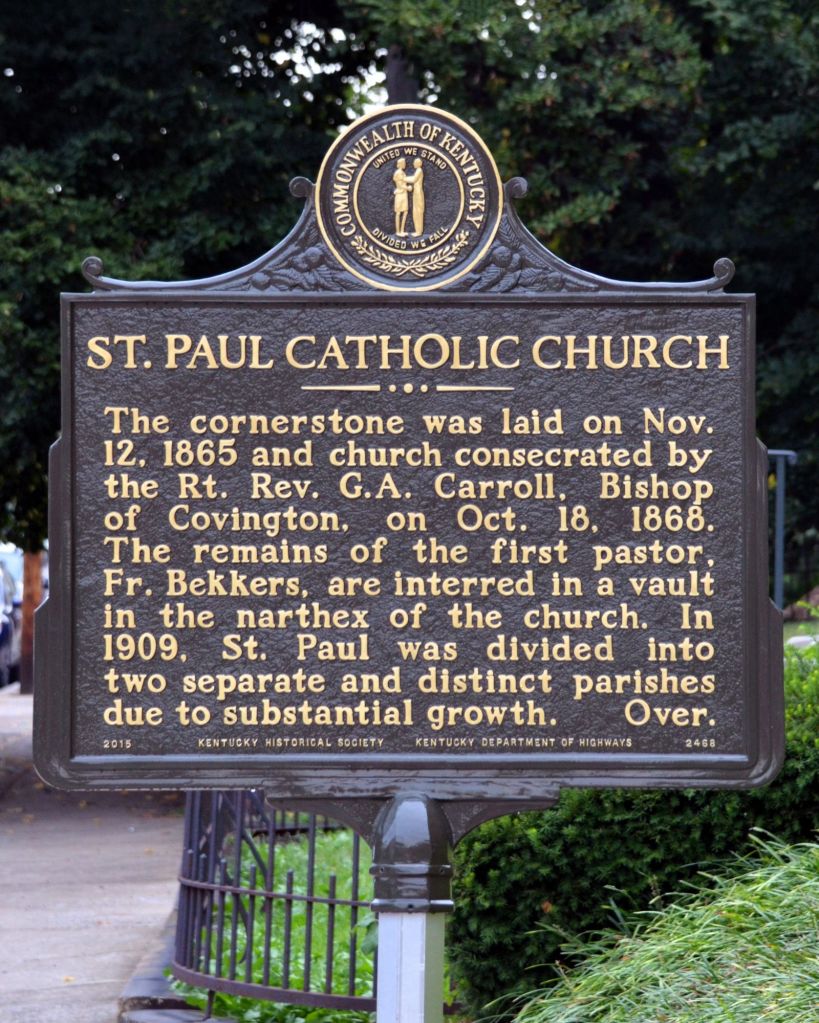
“The cornerstone was laid on Nov. 12, 1865 and church consecrated by the Rt. Rev. G.A. Carroll, Bishop of Covington, on Oct. 18, 1868. The remains of the first pastor, Fr. Bekkers, are interred in a vault in the narthex of the church. In 1909, St. Paul was divided into two separate and distinct parishes due to substantial growth.”
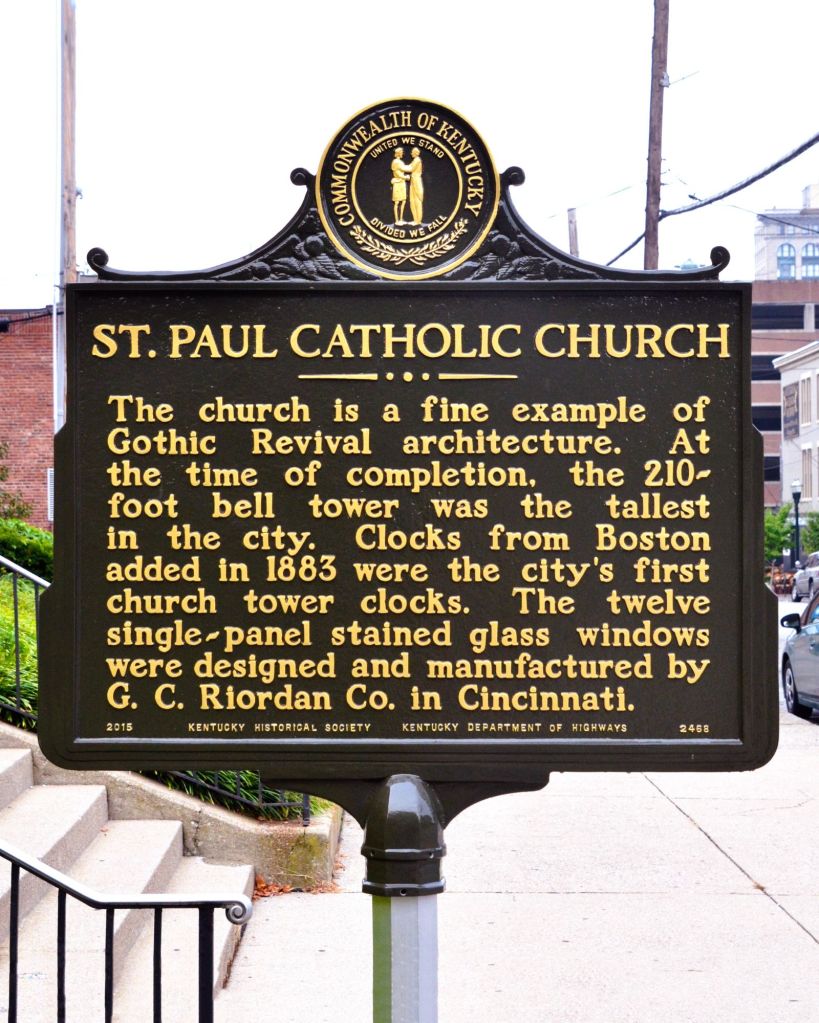
“The church is a fine example of Gothic Revival architecture. At the time of completion, the 210-foot bell tower was the tallest in the city. Clocks from Boston added in 1883 were the city’s first church tower clocks. The twelve single-panel stained glass windows were designed and manufactured by G. C. Riordan Co. in Cincinnati.”
Kentucky Historical Society, Marker No. 2468 — erected 2015
425 W. Short St., Lexington | 38° 03′ 01″ N, 84° 30′ 00″ W — Directions: MapQuest
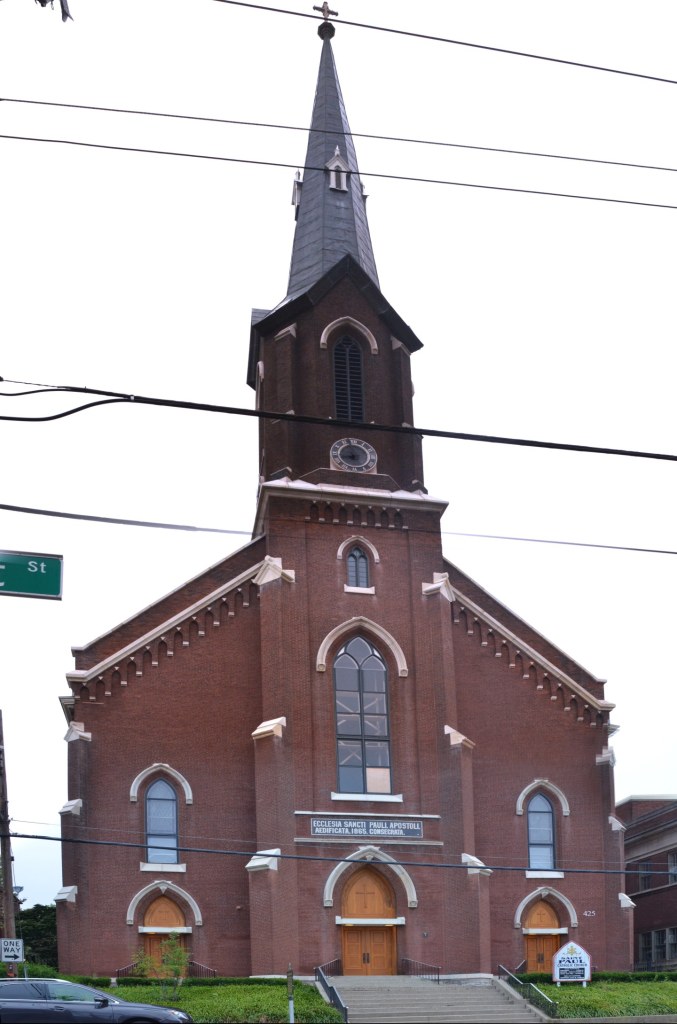
Stand on the sidewalk in front of St. Paul and look up. The brick facade climbs in stages, from the three Gothic-arched doorways, each capped by a stone hood mold, past the tall center window and the Latin inscription, to a square tower, a clock, and finally a slate spire topped with a cross. The inscription over the main door reads “Ecclesia Sancti Pauli Apostoli, Aedificata 1865, Consecrata”: the Church of St. Paul the Apostle, built 1865, consecrated. It is a building designed to be seen from a distance, and for a time it could be seen from farther away than anything else in Lexington.
The marker packs a lot into two panels: a cornerstone, a consecration, a pastor in a vault, a parish split, a record-setting tower, Boston clocks, and Cincinnati glass. Most of it holds up. A few pieces deserve a closer look, including one detail that cannot be right as written.
A Parish Older Than Its Church
St. Paul’s congregation is much older than the building on Short Street. Catholic settlers in the Lexington area asked Archbishop John Carroll of Baltimore for a priest in the early 1790s. Father Stephen Theodore Badin arrived in 1793 to serve several scattered Kentucky settlements. For years, Mass was said in private homes. By 1801 the faithful had a log chapel between Main and Short Streets, known by 1808 as St. Peter’s.
On St. Patrick’s Day, 1811, Father Badin and Father Thomas O’Flynn started a subscription drive for a permanent church. Two years later the congregation paid $312 for a lot owned by General Robert Todd and his wife, Nancy Ann. Todd, one of Lexington’s founders and a great-uncle of Mary Todd Lincoln, died the following year. A small brick Gothic chapel soon went up on the lot, on Third Street east of North Limestone. In 1837 the parish moved into a larger church on North Limestone, then called Mulberry Street, paid for in part by money Father Edward McMahon raised on a fundraising tour of New Orleans.
So when the cornerstone of St. Paul was laid, Lexington’s Catholics were not founding something new. They were moving an existing parish, with more than seventy years of history, into a much larger and far more visible home. The old North Limestone church was kept as a mission. That detail matters later in the story. (Even some modern references blur this lineage and describe St. Paul as the city’s first Catholic church, built in 1813. The 1813 church was St. Peter’s.)
Building a Landmark in 1865
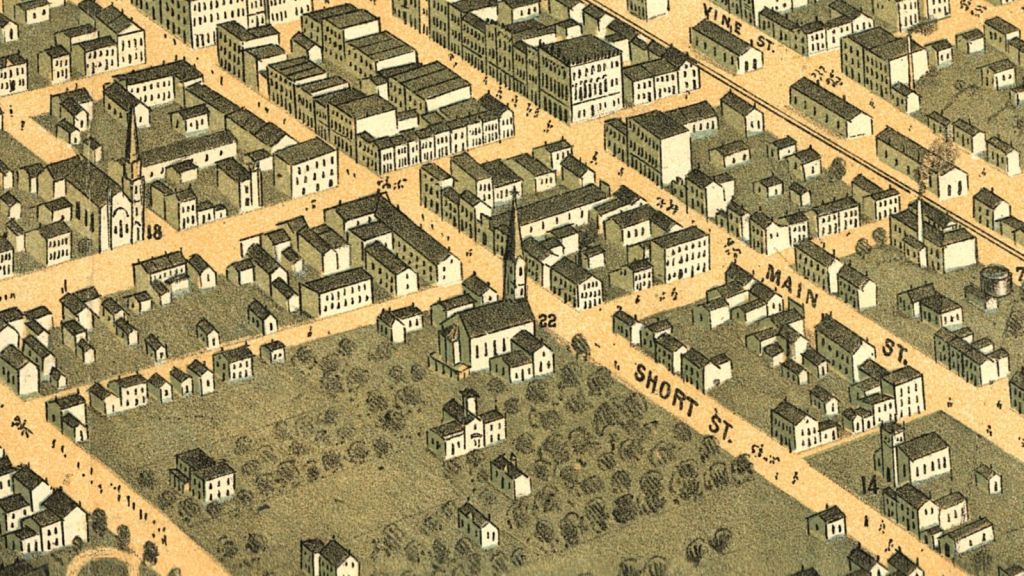
Father John H. Bekkers became pastor in 1864. The design work went to Piket & Son of Cincinnati, a firm often recorded under the anglicized spelling Pickett. Anton Piket and his son Louis specialized in Catholic churches, and by 1865 they had already designed two Cincinnati landmarks: Immaculata Church, completed in 1859 on the heights of Mount Adams, and St. Francis Xavier Church downtown, completed in 1860. According to the 1975 National Register nomination for Lexington’s Western Suburb Historic District, the local builder was either Cincinnatus Shryock or Julian S. Hoagland. The cornerstone was laid in November 1865, only months after the Civil War ended.
The timing gives the building a meaning the marker leaves out. A decade earlier, Kentucky had been a stronghold of the Know Nothing movement, a political party built largely on hostility to Catholic immigrants, most of them Irish and German. In 1855 the party won the governor’s office, and on election day that August, nativist mobs in Louisville kept Catholics from the polls; the rioting known as Bloody Monday left 22 people dead. Nothing comparable happened in Lexington, and there is no direct link between the riot and St. Paul. But every Catholic in the state lived through that period, and the memory was recent when the congregation decided to build. The political party collapsed within a few years, and Catholics’ service on both sides of the Civil War did much to blunt the old charge that they could not be loyal Americans.
Against that background, the scale of the new church stands out. A congregation that had worshiped in a log chapel, and then in modest buildings off the main streets, chose to put up a Gothic church on a prominent downtown lot, with a bell tower taller than any other structure in the city. The effect was plain. After 1868, anyone looking at Lexington’s skyline saw a Catholic cross at the top of it.
The Bishop Who Could Not Have Been There
The marker says the church was consecrated “by the Rt. Rev. G.A. Carroll, Bishop of Covington, on Oct. 18, 1868.” That sentence has two problems.
The first is the spelling. Lexington fell within the Diocese of Covington from 1853 until the Diocese of Lexington was created in 1988, and Covington’s first bishop was George Aloysius Carrell, spelled with an ‘e’. The marker spells the name like that of Archbishop John Carroll, the first Catholic bishop in the United States, a far more familiar name and an easy mix-up.
The second problem is harder to explain. Bishop Carrell died in Covington on September 25, 1868, more than three weeks before the date on the marker. He could not have consecrated the church in October.
Either the date or the name is wrong. The consecration may have taken place earlier in 1868, while Carrell was still alive, or another bishop may have presided in October, after his death. The parish’s own history says only that the church was “dedicated and consecrated in 1868.” We have not found a contemporary account that settles the question. If you know of one, a newspaper notice or a diocesan record, we would like to hear from you.
Father Bekkers
The marker gives Father Bekkers a single line, noting that his remains lie in a vault in the narthex, the entry hall just inside the front doors. He deserves more detail. Bekkers was the pastor who saw the church built, and his work reached well beyond Short Street. He opened the parish school, helped establish St. Joseph Hospital, which the Sisters of Charity of Nazareth founded in Lexington in 1877, and acquired the land for Calvary Cemetery, which is still in use today.
Burial inside a church was an honor usually reserved for founders and benefactors. For the parishioners who walk through the narthex each week, the man who built the place is, in a literal sense, still at the door.
Clocks, Glass, and a Very Tall Tower
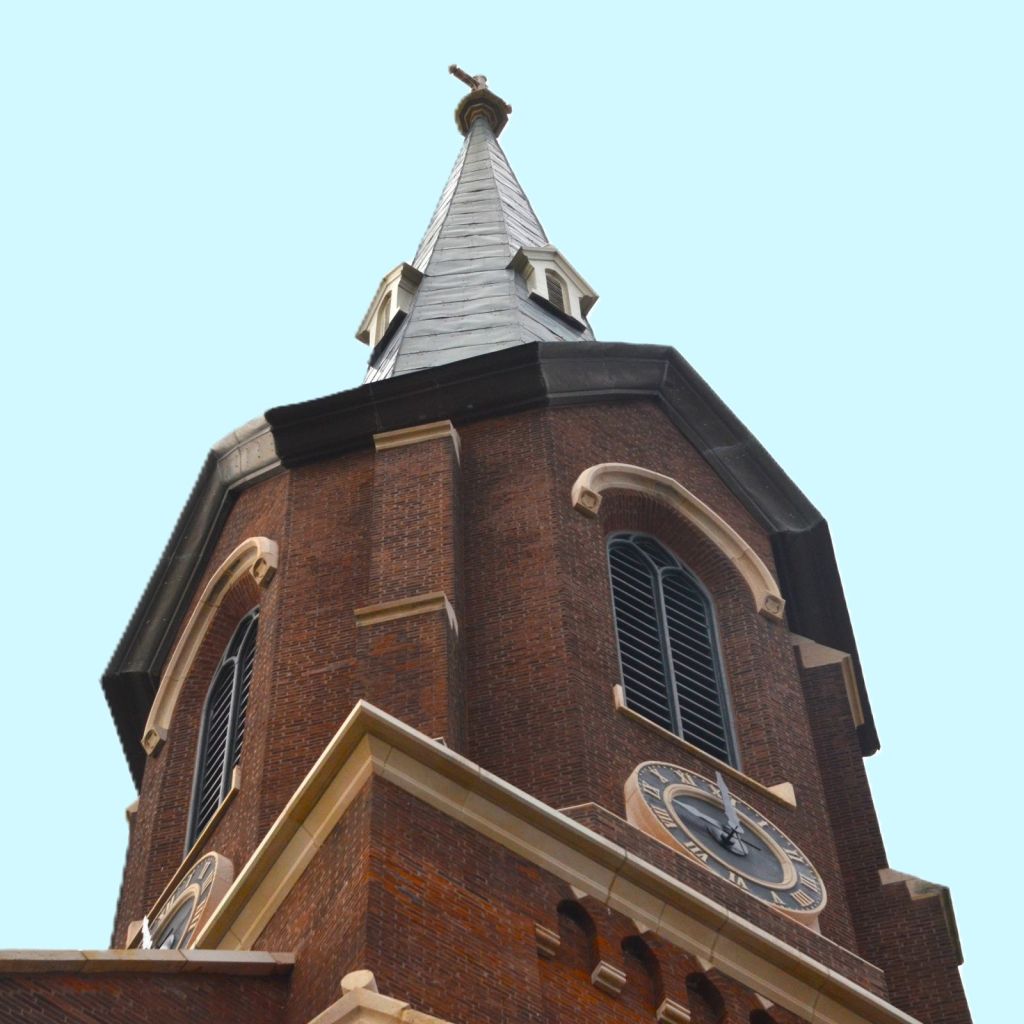
The marker’s reverse side panel turns from people to the building itself. The tower clocks, purchased from Boston and installed in 1883, are described as the first church tower clocks in the city, and the parish’s newspaper record confirms a new clock that year.
The twelve single-panel stained glass windows are credited to the G. C. Riordan Company of Cincinnati. That detail raises a question about when they were installed. The studio traces its roots to a Cincinnati glass shop opened in 1838, but it did not carry the Riordan name until the early 1890s, when Gerald Collins Riordan, an Irish immigrant who had managed the business since 1884, bought it and renamed it G. C. Riordan & Co. If the windows were made by the firm under that name, they are not original to 1868 but part of a later round of work, a common pattern as parishes replaced plain early glass with pictorial windows once they could afford it. The National Register nomination supports that reading. It describes the windows as memorials to distinguished Lexingtonians, among them Col. E. R. Bradley, the horseman whose Idle Hour Farm produced four Kentucky Derby winners. Riordan glass is a familiar sight in the region; much of the stained glass in the Victorian houses of Newport, Kentucky’s East Row Historic District came from the same studio. The company still operates today as BeauVerre Riordan Studios in Middletown, Ohio, and describes itself as the oldest continuously operating stained glass studio in the country.
The marker does not mention another notable feature in the church: fourteen Stations of the Cross, painted in oil on canvas in 1884 and 1885 by Julius Frank (1826–1908), a Munich history painter trained at the city’s Academy of Fine Arts, whose other work includes altarpieces for Bavarian churches, a mural cycle for the Bavarian National Museum, and frescoes at Stonyhurst College in England.
The claim that the 210-foot tower was the tallest structure in Lexington is repeated in nearly every account of the church, but we could not find an independent measurement or a comparison with the city’s other steeples of the 1860s. It is very likely true. Lexington in 1870 was a city of roughly 15,000 people, with no commercial buildings anywhere near that height. Still, it is best understood as parish tradition rather than a documented record.
“Due to Substantial Growth”
The marker’s account of 1909 is accurate as far as it goes: on June 27 of that year, St. Paul was divided, and 291 families were assigned to a new parish. The marker does not say which parish that was.
It was St. Peter. The name Lexington’s first Catholic congregation had carried since the log chapel days, reduced to a mission when St. Paul opened in 1868, became a full parish again under Father William Punch. The new parish’s members worshiped in the old North Limestone church, which had been kept as a mission for four decades, until they could build their own. Their present church on Barr Street was dedicated on April 7, 1929.
The growth was real. Lexington had gone from about 16,600 people in 1880 to more than 35,000 by 1910, and one downtown parish was no longer enough. But “substantial growth” explains why the division happened, not what it was.
Two Churches, One Beginning
St. Paul marked its centennial in 1968 with a remodeling project that cost about $200,000. Twenty years later, when the Diocese of Lexington was created from parts of the Diocese of Covington and the Archdiocese of Louisville, the church became part of a diocese based in its own city for the first time.
The longer thread, though, is the one the marker skips. Lexington today has both churches: St. Paul on Short Street and St. Peter on Barr Street, on opposite sides of downtown. Both trace their roots to the same log chapel and to Father Badin’s arrival in 1793. In 1868, St. Paul got the landmark, and St. Peter kept the name, waiting as a mission in its old church on North Limestone.
Read that way, “divided into two separate and distinct parishes due to substantial growth” undersells what happened in 1909. The parish that separated from St. Paul was not an offshoot. It was the original, returning after forty years because the city had finally grown enough to need it again. Standing under the tower on Short Street, you are looking at the building that replaced Lexington’s first Catholic parish. Across downtown, the parish it replaced is still holding Mass.
Sources consulted: Historic St. Paul Catholic Church, parish history (saintpaul.cdlex.org); St. Peter Catholic Church, “Our History” (stpeterlex.org); Kentucky Historical Society marker database; National Register of Historic Places, Western Suburb Historic District nomination (1975); Michigan Technological University, Copper Country Architects, “Louis Piket”; Wikipedia, “Immaculata Church” and “St. Francis Xavier Church (Cincinnati, Ohio)”; Historical Marker Database (hmdb.org), entry 119120; Kenton County Public Library, biography of Bishop George Aloysius Carrell; Diocese of Covington, “19th century Know Nothings and anti-Catholicism”; BeauVerre Riordan Studios, company history; WVXU, “OKI Wanna Know: What’s with all the stained glass windows in some neighborhoods?”; Wikipedia (German), “Julius Frank (Maler)”; Wikipedia, “Robert Todd (pioneer)”; Wikipedia, “George Aloysius Carrell,” “Roman Catholic Diocese of Lexington,” and “Timeline of Lexington, Kentucky.”



I’m eager to hear what you think