Listen to this story
Narration is AI-generated from the text of this article.
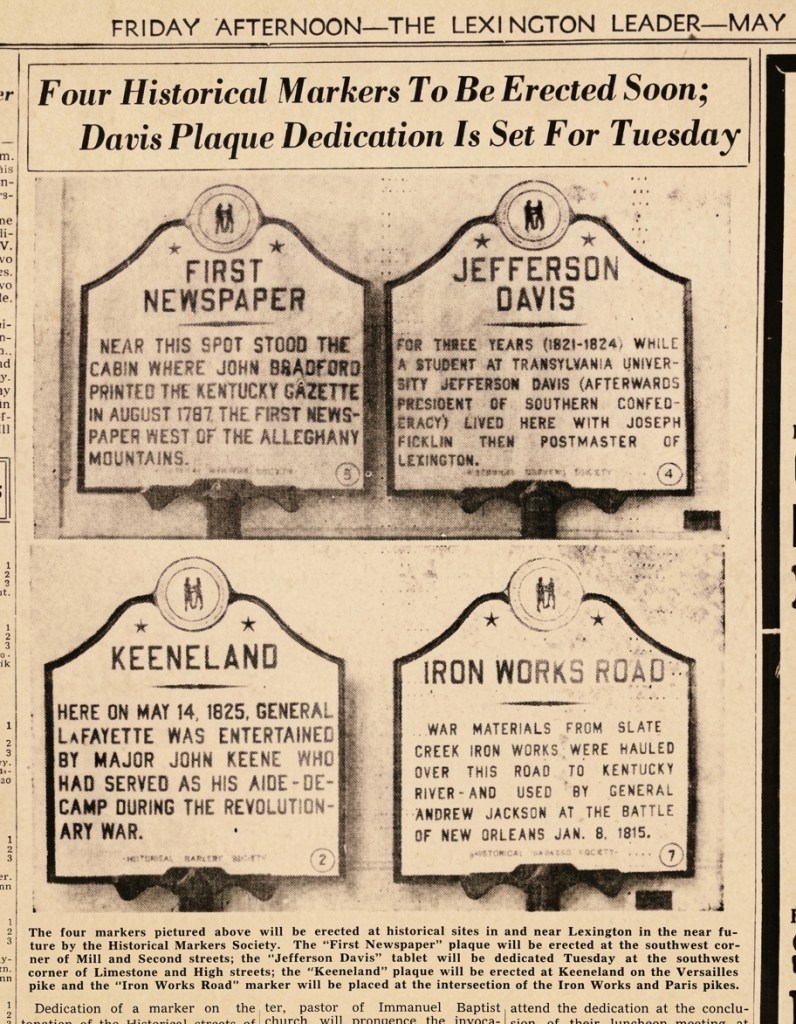
“Here on May 14, 1825, General LaFayette was entertained by Major John Keene who had served as his Aide-De-Camp during the Revolutionary War.”
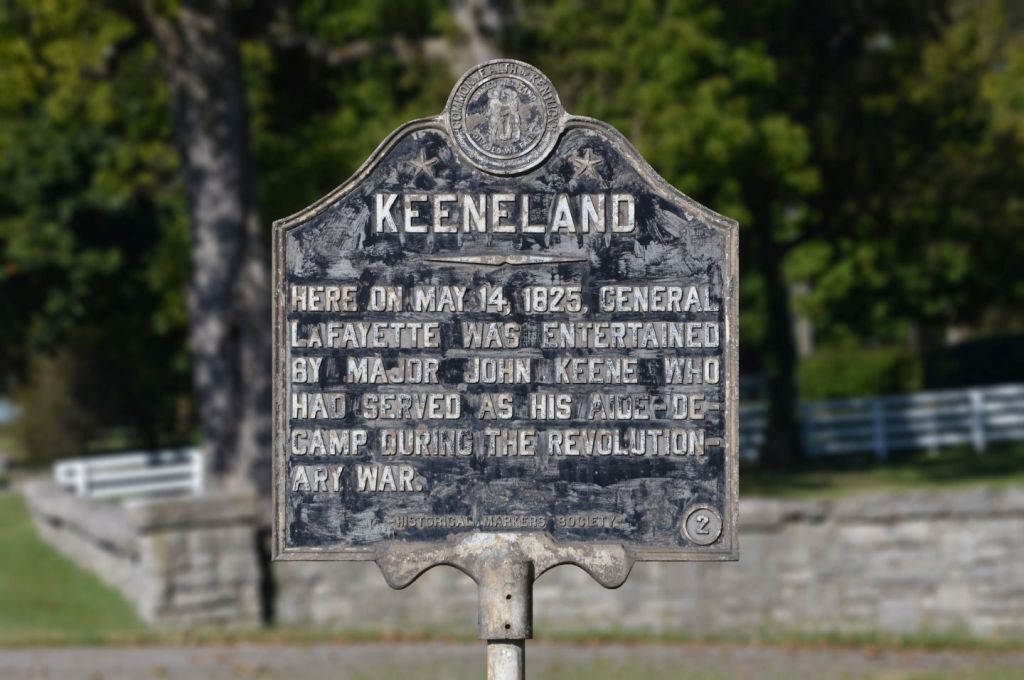
Kentucky Historical Society, Marker No. 2 — erected by the Historical Markers Society of Lexington, 1936
4201 Versailles Rd. (US 60), Lexington | 38° 02′ 36″ N, 84° 35′ 59″ W — Directions: MapQuest
Marker No. 2 stands at the edge of one of the most famous racetracks in the world, and it says nothing about horses. It is about a guest. In May 1825 the Marquis de Lafayette, the French nobleman who had fought for American independence as a teenager, spent a night on this land on his way into Lexington. Fayette County had been named for him in 1780, when he was twenty-three. This was the only time he ever saw it. The plaque is old, too. It was the second historical marker put up in Kentucky, placed by a private Lexington group, the Historical Markers Society, in the spring of 1936; the first went up at Lexington’s Ashland Estate. The marker stood on the Versailles pike before the racetrack did. Keeneland held its first races that October.
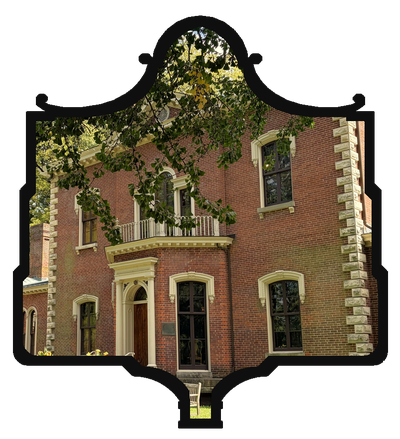
The plaque is one sentence long, and one of its details does not hold up well: the claim that his host had been Lafayette’s aide-de-camp cannot be true. Its date is also a day early. The visit itself is real and well documented, and so is the house where it happened. That house is still here, on the Keeneland grounds, where the track’s grounds map labels it Keene Place.
The Nation’s Guest
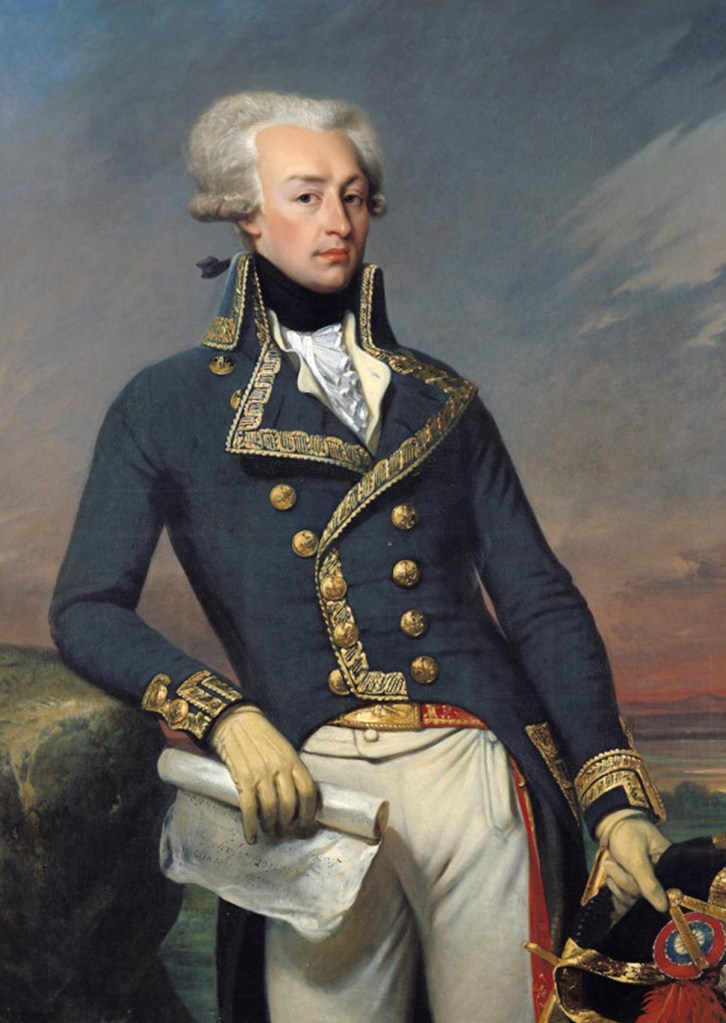
Lafayette came back to the United States in August 1824 at the invitation of President James Monroe, as the country approached the fiftieth anniversary of independence. He was sixty-six. He had been nineteen when he joined the Continental Army in 1777, and he had been wounded at the Battle of Brandywine, fought along Brandywine Creek southwest of Philadelphia, that September. As a teenage major general he had been younger than most of the men he led. Nearly fifty years later, the soldiers who had followed him were in their sixties, seventies, and eighties, and most of them were already gone. Americans treated him as a living link to the generation that had founded the country.
His tour lasted more than a year. Lafayette traveled with his son, George Washington Lafayette, and his secretary, Auguste Levasseur, who kept a detailed journal of the trip, published in 1829 as the book Lafayette in America in 1824 and 1825. Together they visited all twenty-four states in the union. To thank him, and because he had lost much of his fortune during the French Revolution, Congress gave him $200,000 and a 36-square-mile tract of public land near to Tallahassee, in the Florida Territory. He never visited. French settlers he sent there in the 1830s found the climate too hot and soon left, and by 1855 the land had been sold off in pieces. Today it lies within Tallahassee, where Lake Lafayette and the Lafayette Oaks neighborhood carry his name. During his tour, towns competed to host him with parades, dinners, balls, and triumphal arches, most of them temporary structures of wood and cloth built for the celebration.
The western leg of the tour was harder than the eastern one. Around midnight on May 8, 1825, on a dark and rainy night, the steamboat Mechanic, carrying Lafayette’s party down the Ohio River toward Louisville, struck a submerged log, called a snag, near what is now Cannelton, Indiana, and sank. Snags were among the most common causes of steamboat wrecks on western rivers. Everyone reached shore, but Lafayette lost money and belongings, and the party waited on the riverbank until another steamboat, the Paragon, picked them up the next day. He reached Louisville on May 11.
Sunday on the Versailles Road
From Louisville, Lafayette went to Frankfort, where he attended a dinner and a ball on May 14. The next morning, Sunday, May 15, the party left Frankfort for Lexington by way of Versailles. Lafayette did not usually travel on the Sabbath, but he made an exception. The roads were wet and the weather was poor. The road east from Versailles had no formal name; like most Lexington roads at the time, it was simply called for the town it led to. It was still a dirt road. Kentucky built its first crushed-stone toll road, from Lexington to Maysville, in 1830, and over the next few decades most of the roads out of Lexington were rebuilt the same way and became known as turnpikes, or “pikes.”
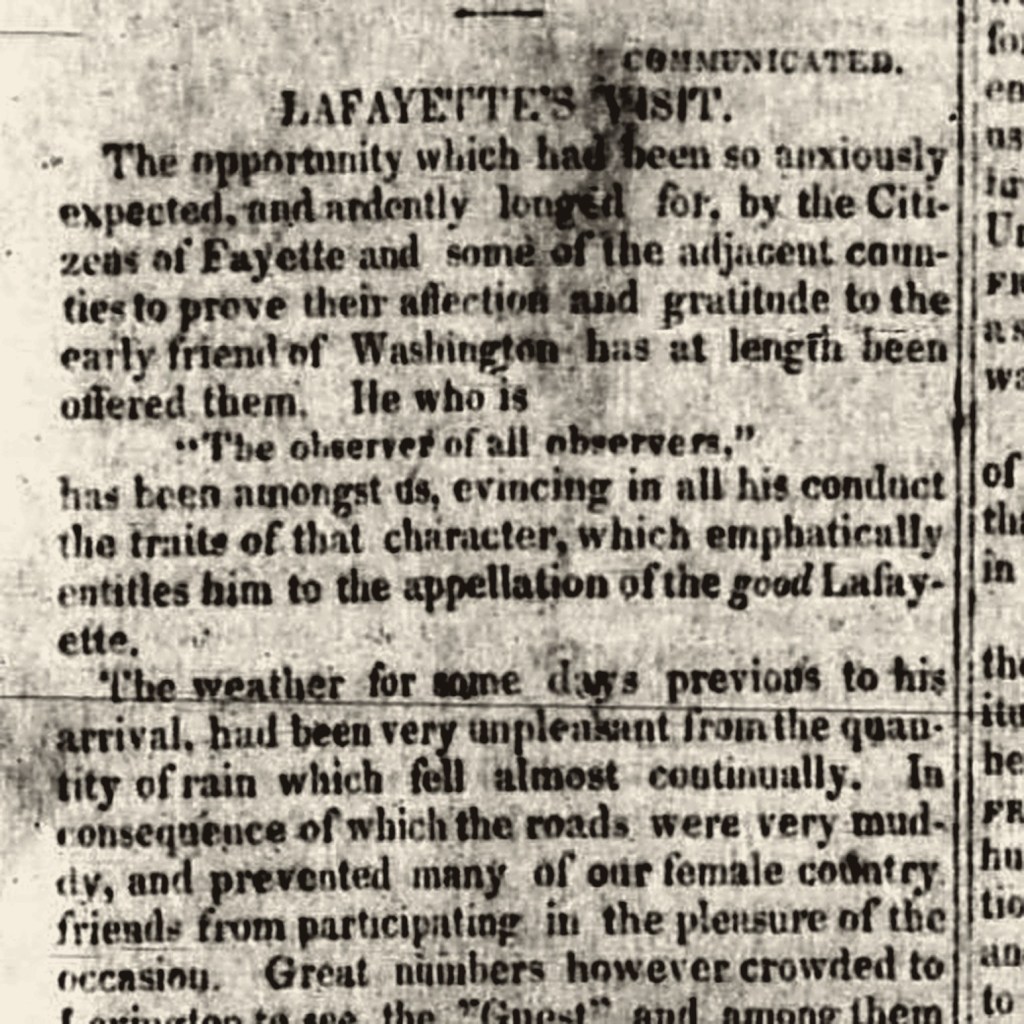
He spent that night about five miles outside Lexington, at the brick house of John and Mary “Polly” Keen, while his military escort camped on the grounds. The next morning a county committee called on him there, and Colonel Leslie Combs, a Lexington lawyer and War of 1812 veteran, read its address of welcome. Lafayette then rode toward Lexington in a four-horse carriage, with Abraham Bowman beside him.
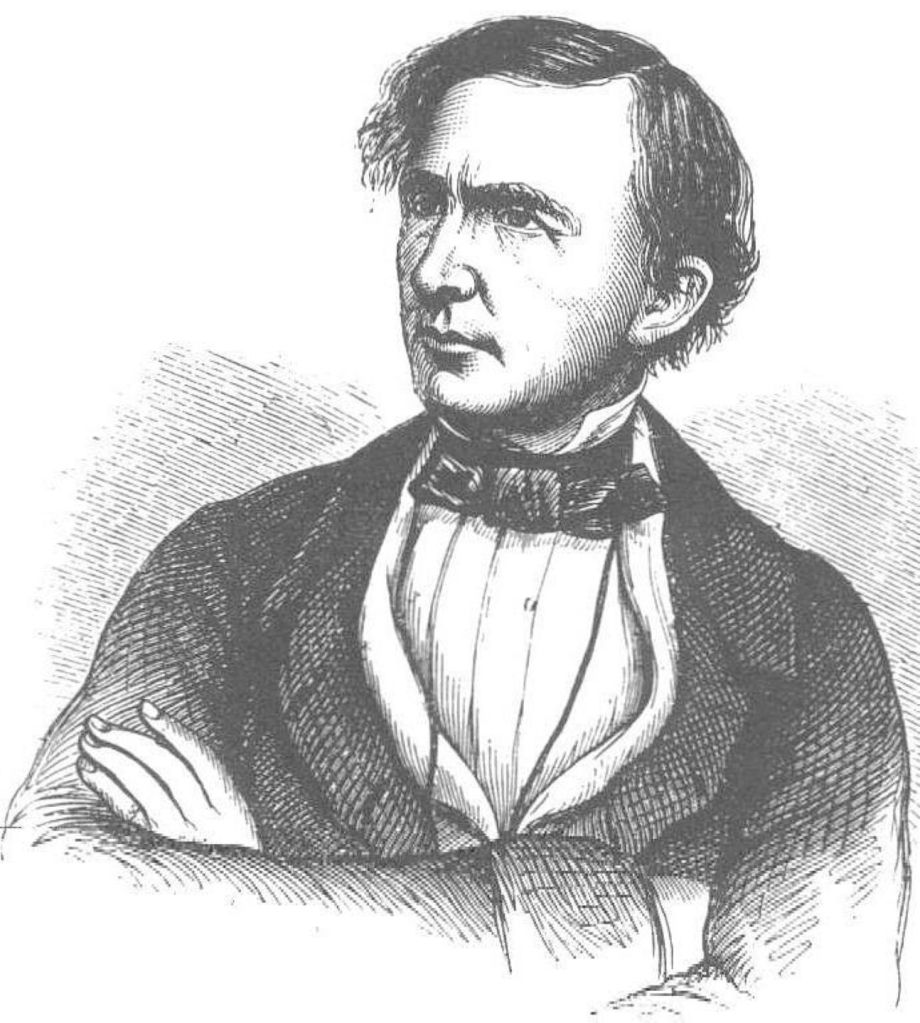
There is a family story behind the choice of house. According to the history told at Keene Place today, Lafayette was supposed to stay a little farther on, at the home of Polly Keen’s father, Colonel Abraham Bowman, whose farm lay along what is now Bowman Mill Road. Bad roads and weather made the Keen house the more practical stop, and Polly hosted him there. Bowman, a Revolutionary War veteran who had settled near Lexington in 1779, is also remembered as one of Lafayette’s hosts during the visit.
The family story is about two households, and it leaves out everyone else on both farms. In 1810 the census counted 16 enslaved people in John Keen’s household. When census takers came to Abraham Bowman’s place in 1820, they counted 21; in 1830, five years after Lafayette’s visit, they counted 24, many of them children. Whoever cooked for Lafayette’s party that night, cared for its horses, and fed the escort camped on the lawn does not appear in the story the families handed down, or on the marker.
What the Plaque Gets Wrong
The problem is the phrase “…who had served as his Aide-De-Camp.” John Keen could not have served on Lafayette’s staff, or in the Revolution at all. His grave and the 1810 census put his birth around 1781, in Virginia, so he was a small child when the war ended. An aide-de-camp was a general’s personal staff officer, and Lafayette’s known aides were mostly French officers who came over with him or after him, such as Jean-Joseph Sourbader de Gimat, who led an assault at Yorktown. The earliest account of the visit does not make the claim either. The Kentucky Gazette’s report, printed three days later, calls his host simply “Mr. John Keen,” and describes Abraham Bowman, who rode beside Lafayette into town, as “an old fellow soldier.” As far as this research found, the “Major” and the aide-de-camp first appear on the plaque cast in 1936.
The family connection to the Revolution runs instead through Abraham Bowman. He was colonel of the 8th Virginia Regiment and led it at Brandywine and at Germantown, then a village just north of Philadelphia, in 1777, and through the Battle of Monmouth, in New Jersey, in 1778. Lafayette fought at both Brandywine and Monmouth. Some modern accounts describe Bowman, not Keen, as Lafayette’s aide-de-camp, and others say only that he was a friend. His own biographers describe a regimental command, not service on Lafayette’s staff. It seems likely that a true story, an old soldier welcoming a commander he had served under, was simplified over time into the version cast in metal, with the son-in-law in the father-in-law’s place. That mix-up may be old. An 1896 application to the Sons of the American Revolution, filed four decades before the marker went up, already lists “John Keen,” husband of Mary Bowman, as a Revolutionary ancestor. The “Major” title is also unexplained; it may come from the militia, as many Kentucky titles did.
The date on the plaque is off as well. Lafayette spent May 14 in Frankfort, at the dinner and ball given in his honor there. His night at the Keen house was the following one, Sunday, May 15, 1825.
None of this changes what happened at the Keen house. Lafayette did spend a night with the Keens, and the family kept the memory of it for two centuries. The plaque simply asks the visit to carry more history than the records can confirm.
Two Days in Lexington
Lexington had about 6,000 residents in 1825 and had been preparing for weeks. Lafayette arrived on May 16 in the rain, and crowds lined the muddy road into town. Many of the men waiting for him were Revolutionary veterans, some of whom showed him the wounds they had received fighting at his side. One held up a right hand missing two fingers, shot away by a musket ball at Brandywine; he had been carried from the field, he said, at the same time as the wounded Lafayette.
For roughly forty-eight hours he was hardly left alone. His quarters in town were at Mrs. Keen’s, a Lexington hotel kept by a Keen whose connection to John Keen is unclear. He was received at Transylvania University, then the leading college in the West, in the chapel of its main building at the head of what is now Gratz Park, where President Horace Holley spoke. He visited a girls’ school that renamed itself the Lafayette Female Academy in his honor; its building stood on North Upper Street. There was a military parade, a Masonic supper and ball for about 800 guests, and a dinner for about 1,400 people in a grove. On May 18 he headed north to Georgetown, and then on to Cincinnati and the east.
A Formal Bow to Lewis Hayden
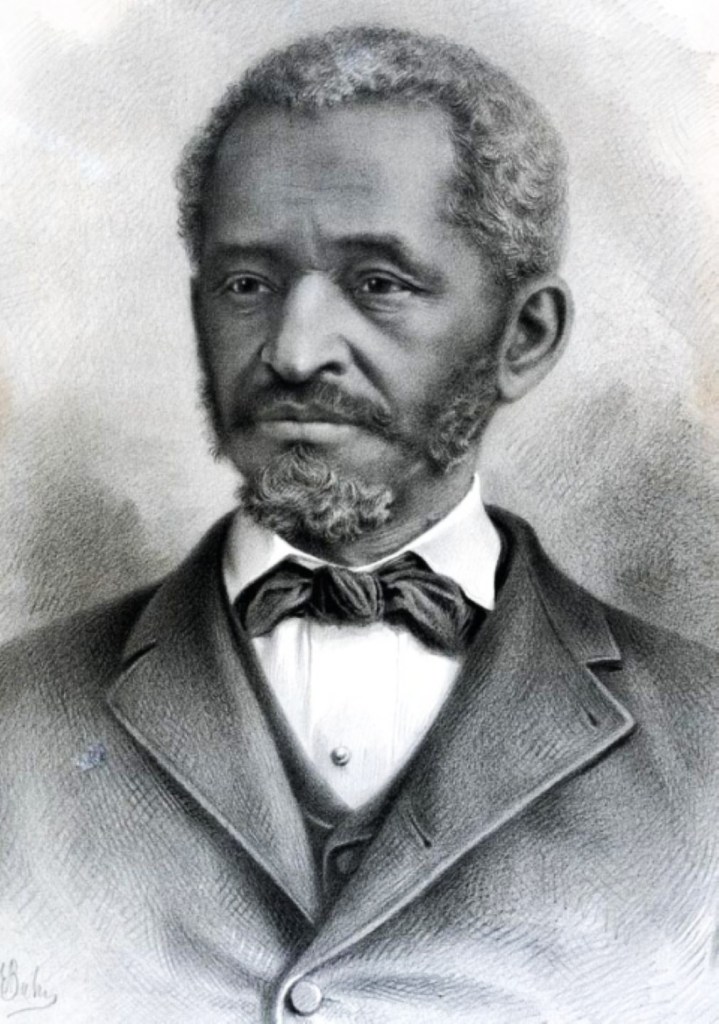
Lafayette was the most famous critic of slavery to tour the United States in those years, and he spent much of the tour in slaveholding states as an honored guest of slaveholders. He had urged George Washington to free the people he enslaved, and in 1785 he bought a plantation in Cayenne, the French colony on the northeast coast of South America now called French Guiana, along with about seventy enslaved people, intending to educate them, pay them, and free them over time. The experiment ended after he fled the French Revolution in 1792 and was captured by Austrian forces, who kept him in Prussian and Austrian prisons for five years. The people on the plantation were sold that same year.
In Lexington the contradiction showed in a small but meaningful moment. As his carriage passed through town on May 16, Lafayette bowed to a young enslaved boy named Lewis Hayden. Hayden never forgot it. He later escaped through the Underground Railroad, settled in Boston, and became one of that city’s leading abolitionists, sheltering people who had escaped slavery in his own house. He wrote that he dated his hatred of slavery from that day.
From Keen Place to Keeneland
The house where Lafayette slept was built in 1805, according to Keeneland, as the home of a branch of the Keen family; some accounts give a date around 1800. The spelling of the name drifted over the generations, and the final “e” became standard later. The family kept the land for nearly 150 years.
Its best-known heir was John Oliver “Jack” Keene (1870–1943), a horse trainer who had worked in Chicago, California, Japan, and Russia, where in 1902 and 1903 he trained for Russian owners and won that country’s major races. Back in Kentucky, Keene began building a private racetrack on the family land in 1916: a one-and-one-sixteenth-mile course, a stone barn with living quarters, and an indoor training area modeled on what he had seen in Russia. He never had the money to finish it.
When the Kentucky Association track, at the east end of Fifth Street in Lexington, closed in 1933, a group of horsemen led by Hal Price Headley looked for a new home for racing. On August 29, 1935, they bought 147 acres of Keene’s land for $130,000 and organized the Keeneland Association as a nonprofit. Keene’s unfinished barn became the clubhouse. Keeneland opened on October 15, 1936, before a crowd of about 8,000. It held its first horse auction in 1938, and its sales have since made it the largest Thoroughbred auction house in the world. In September 2026 its yearling sale alone brought in more than $536 million, the highest total ever recorded at a Thoroughbred auction. Keeneland was named a National Historic Landmark in 1986.
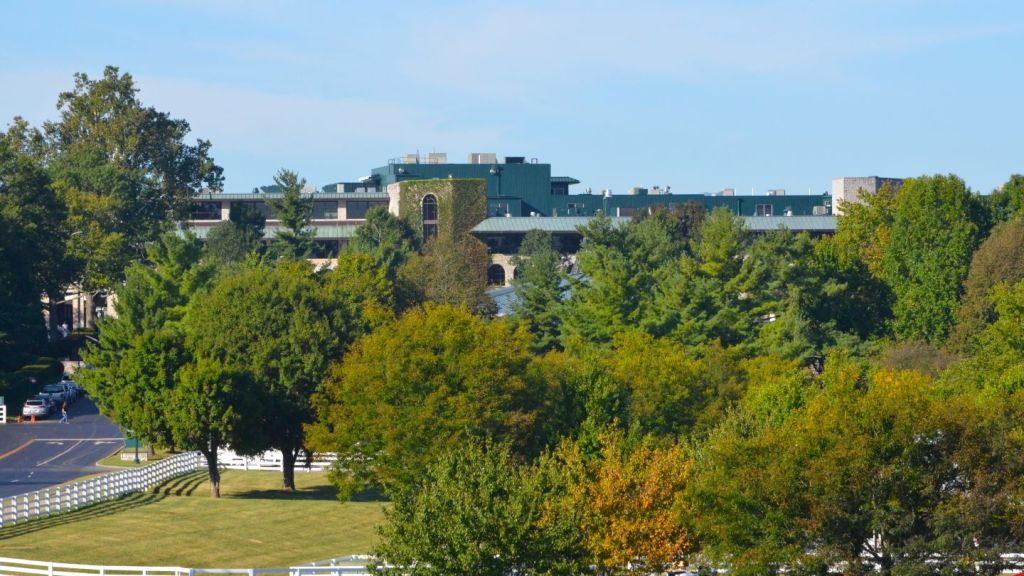
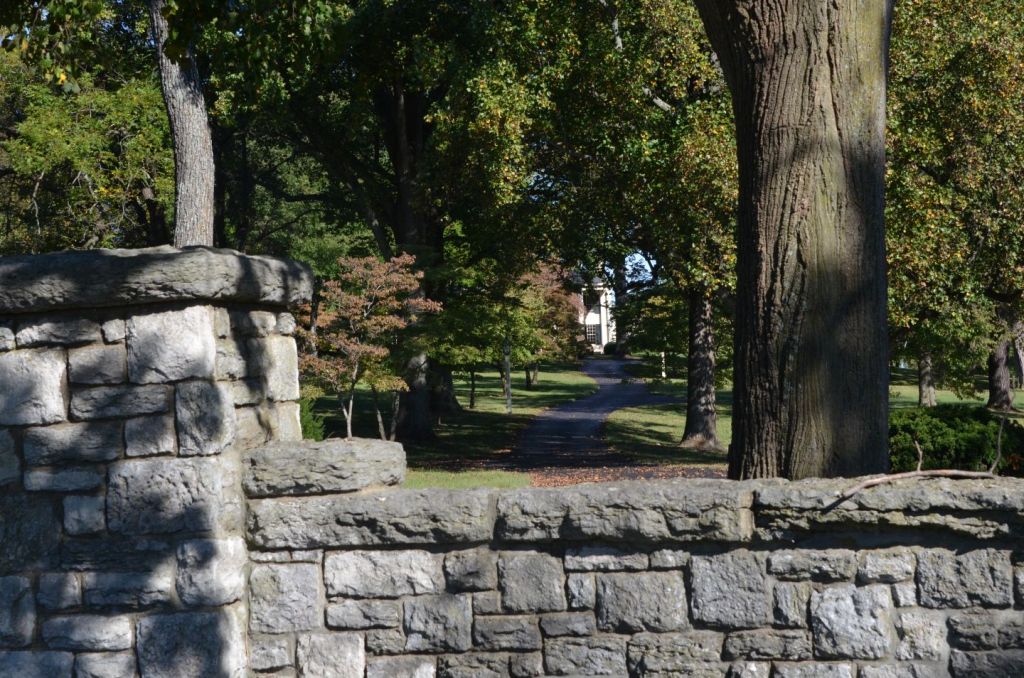
The old house stayed in the family until 1948. Keeneland bought it, with fifteen acres, in 2003 and reopened it as an event space in 2009 after a careful restoration. A small Keene family cemetery behind the house still belongs to the family; John Keen, who died in 1827, two years after Lafayette’s visit, is buried there. In May 2025, for the 200th anniversary of the visit, Keeneland held a reception at Keene Place.
The Guest Before the Horses
Most people who drive past Marker No. 2 are thinking about racing, and the plaque makes no effort to change that. It records a much older moment on the same ground: a tired, famous old man, a day out from Frankfort, stopping for the night at a farmhouse on a wet Sunday because the roads were bad. The details on the plaque may be off a bit, but the house he slept in is still standing a short walk from the paddock.
Sources consulted: Kentucky Gazette, “Lafayette’s Visit” (May 19, 1825); Lexington Weekly Press (May 21, 1825); Lexington Herald (April 5, 1936); Lexington Leader (May 8, 1936); Kentucky Historical Society marker database and ExploreKYHistory entry for Keeneland (Marker No. 2); Kentucky Historical Society, “Marquis de Lafayette: ‘The Friend of Liberty’ and the Paradox of Slavery,” Kentucky Ancestors; Auguste Levasseur, Lafayette in America in 1824 and 1825 (1829); Ray E. Boomhower, “Swamped: The Marquis de Lafayette’s Indiana Adventure” (2020); Lexington Public Library, Lafayette’s Visit to Lexington walking tour; Northern Kentucky Tribune, “Kentucky’s Historical Marker Program One of Oldest, Largest in the United States”; Wikipedia, “Kentucky Association” and “Lafayette Land Grant”; “Local-Scale Turnpike Roads in Nineteenth-Century Kentucky,” Journal of Historical Geography; Wikipedia, “Visit of the Marquis de Lafayette to the United States”; Encyclopedia Virginia, “Abraham Bowman”; Daughters of the American Revolution, Honoring Our Patriots; U.S. Federal Census, Fayette County, Kentucky, 1810, 1820, and 1830; Find a Grave, John Keen(e) (1781–1827); will of Francis Keene, Kentucky Wills and Probate Records; Sons of the American Revolution membership applications index (1896); National Park Service, Colonial National Historical Park, biography of Jean-Joseph Sourbader de Gimat; Transylvania University Library, “Lafayette in Lexington”; Lafayette College Magazine, “In the Marquis’ Footsteps” (2019); Smiley Pete Publishing, “A Keene Interest in History” (2012); Keeneland Library, “Purchase of Keene Place, 2003”; National Register of Historic Places nomination, Keeneland Race Course; America’s Best Racing, “For Love of the Horse, For Generations to Come: A History of Keeneland Race Course” (2025); WUKY (May 15, 2025); Daily Racing Form (September 26, 2026); Sam Terry’s Kentucky, “Lafayette’s Visit to Versailles and Keene Place.”




I’m eager to hear what you think