“MAN O’ WAR”
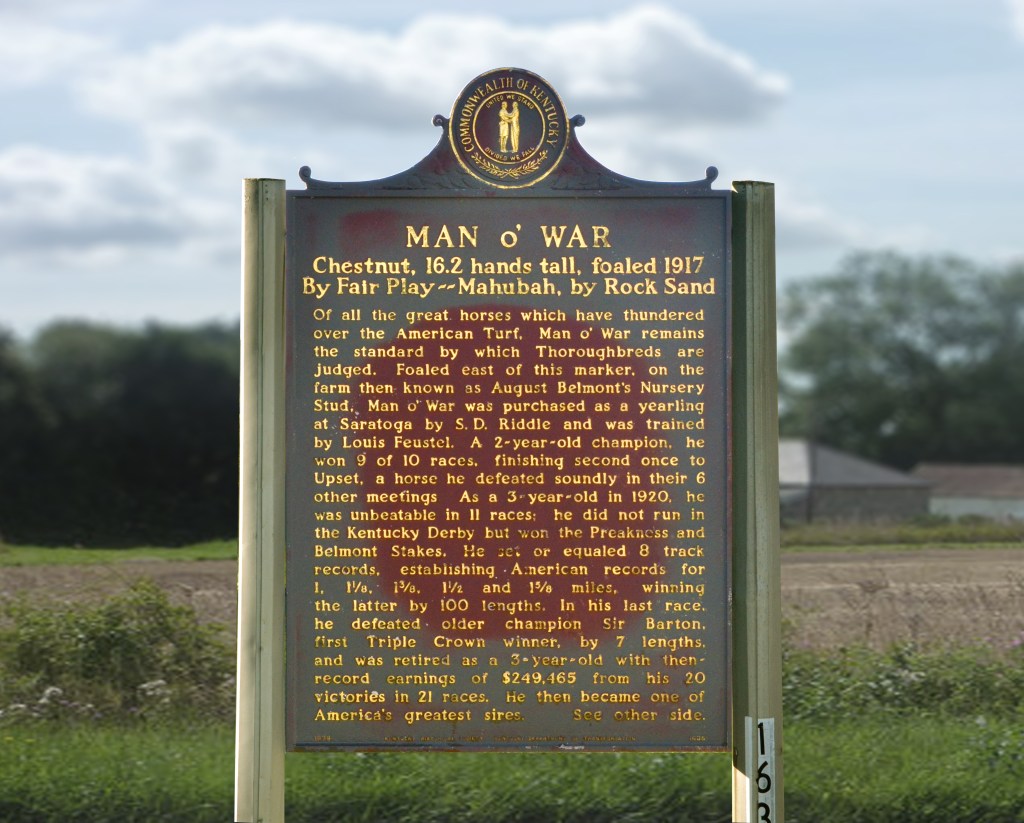
Chestnut, 16.2 hands tall, foaled 1917
By Fair Play — Mahubah, by Rock Sand
Of all the great horses which have thundered over the American Turf, Man o’ War remains the standard by which Thoroughbreds are judged.Kentucky Historical Society, Marker No. 1635
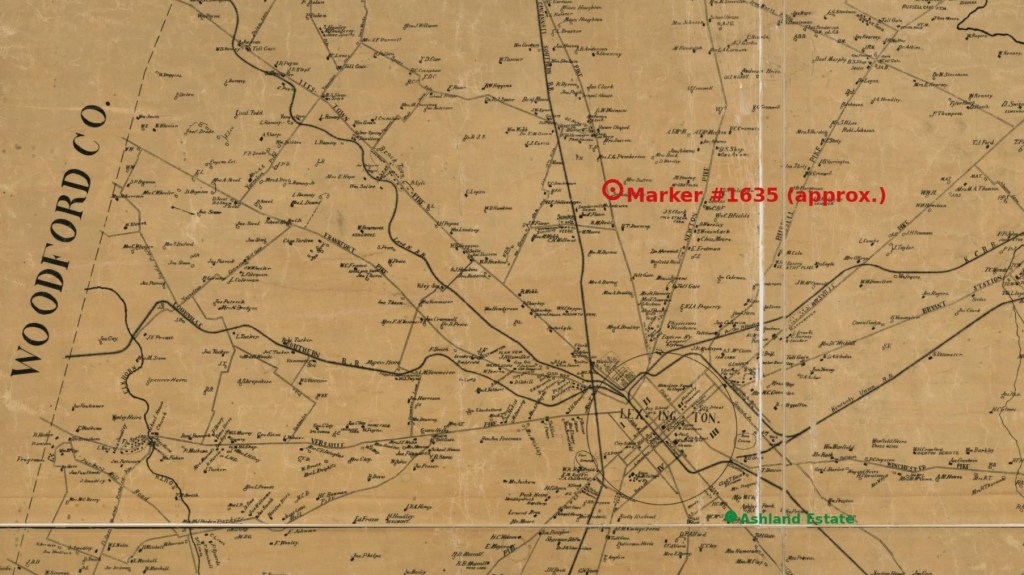
US 25 (Paris Pike), near the former site of August Belmont’s Nursery Stud, about 4 miles north of Lexington, Kentucky | 38° 5′ 58″ N, 84° 30′ 49″ W — Directions: MapQuest
Most of Kentucky’s roadside markers commemorate people — statesmen, soldiers, ministers, the occasional scandal. Marker #1635 commemorates a horse. That alone tells you something about how central the Thoroughbred industry is to this stretch of the Bluegrass, and how singular this particular horse was. A century after his last race, Man o’ War is still the name people reach for when they want to describe an athlete who wasn’t just good, but seemed to operate on different physics than everyone else on the track.
A War Baby, Sold Almost by Accident
Man o’ War was foaled on March 29, 1917, at Nursery Stud, a farm a few miles from where his marker now stands, one of 1,680 Thoroughbreds born in America that year. His breeder was August Belmont II, the financier and sportsman whose father’s name is on Belmont Park. His sire was Fair Play, a fast but famously ill-tempered stallion descended from the equally hot-headed Hastings; his dam was Mahubah, an even-keeled mare by the English Triple Crown winner Rock Sand, bred to Fair Play specifically to blunt the temper with some calm. It mostly worked.
The name itself came from Belmont’s wife, Eleanor. With the United States newly at war and her husband, in his fifties, headed overseas with the Army, she named the colt in his honor: her Man o’ War. It was Belmont’s wartime service, not any lack of confidence in the colt, that put Man o’ War on the auction block in the first place: Belmont sold off his entire yearling crop at Saratoga in 1918 before shipping out. A Pennsylvania horseman named Samuel D. Riddle bought the gawky chestnut for $5,000. Riddle would later turn down offers reportedly north of $300,000 to sell him back.
The One Loss
As the marker notes, Man o’ War won nine of ten races as a two-year-old in 1919, “finishing second once to Upset, a horse he defeated soundly in their 6 other meetings.” That single loss, in the Sanford Memorial Stakes at Saratoga on August 13, 1919, has been picked over by racing historians for more than a century, and it’s worth understanding why, since the marker compresses a genuinely strange story into one line.
There was no starting gate in 1919 — horses lined up behind a webbed barrier, and a substitute starter that day struggled badly to get the field square. Man o’ War, drawn wide, broke either sideways or nearly backward depending on which account you believe, and lost several lengths before the race had really begun. His jockey, Johnny Loftus, tried to angle him back to the rail and got boxed in at exactly the wrong moment. Man o’ War was also conceding 15 pounds to Upset under the era’s weight-for-performance rules. He lost by a neck.
The stranger part came the following year, when The Jockey Club quietly declined to renew the riding licenses of both Loftus and Upset’s jockey, Willie Knapp — with no explanation given, then or ever. Neither man rode professionally again, though both went on to careers as trainers, and both denied to their graves that anything improper had happened in the race. Whether the license denials were connected to the Sanford Memorial has never been established one way or the other; it remains one of the small unresolved mysteries of the sport. What’s not in dispute is what happened next: Man o’ War beat Upset in all six of their subsequent meetings, and never lost again.
An Unbeaten Season, and a Derby He Never Ran
The marker’s claim that Man o’ War “was unbeatable in 11 races” as a three-year-old checks out cleanly — he won every start in 1920, including the Preakness and Belmont Stakes, and set or equaled eight track and American records along the way, from the mile up through the mile-and-five-eighths, the latter by 100 lengths. It’s worth pausing, though, on the one race he’s most often asked about: the Kentucky Derby, which he never ran.
A popular version of the story — repeated on more than one roadside-history site — holds that Riddle simply refused to race his horse in Kentucky. That’s an overstatement of what actually happened. Riddle’s stated reasoning was about the distance and timing: he believed a mile and a quarter was too demanding a test for a three-year-old that early in May, and he preferred to campaign Man o’ War on the Northeastern racing circuit he knew best. The 1920 Derby went to Paul Jones, a colt Man o’ War had already beaten easily earlier that year, and most racing historians agree Man o’ War would very likely have won it too. But “declined to enter” and “refused to race in Kentucky” are different claims, and the marker text itself, to its credit, states only the plain fact: he didn’t run in it.
His last race, that October, may be the single line of the marker’s text worth sitting with longest: “he defeated older champion Sir Barton, first Triple Crown winner, by 7 lengths.” Sir Barton had swept all three Triple Crown races the year before Man o’ War was even racing seriously. Beating him by seven lengths, in what amounted to a coronation match at Kenilworth Park in Ontario, was as close as the sport got to settling an argument about which horse was actually the best of his era. Man o’ War retired immediately afterward, a three-year-old, with record earnings of $249,465 from 20 wins in 21 starts — a career that lasted barely a year and a half and left almost nothing else for anyone to prove.
Champion and Sire of Champions
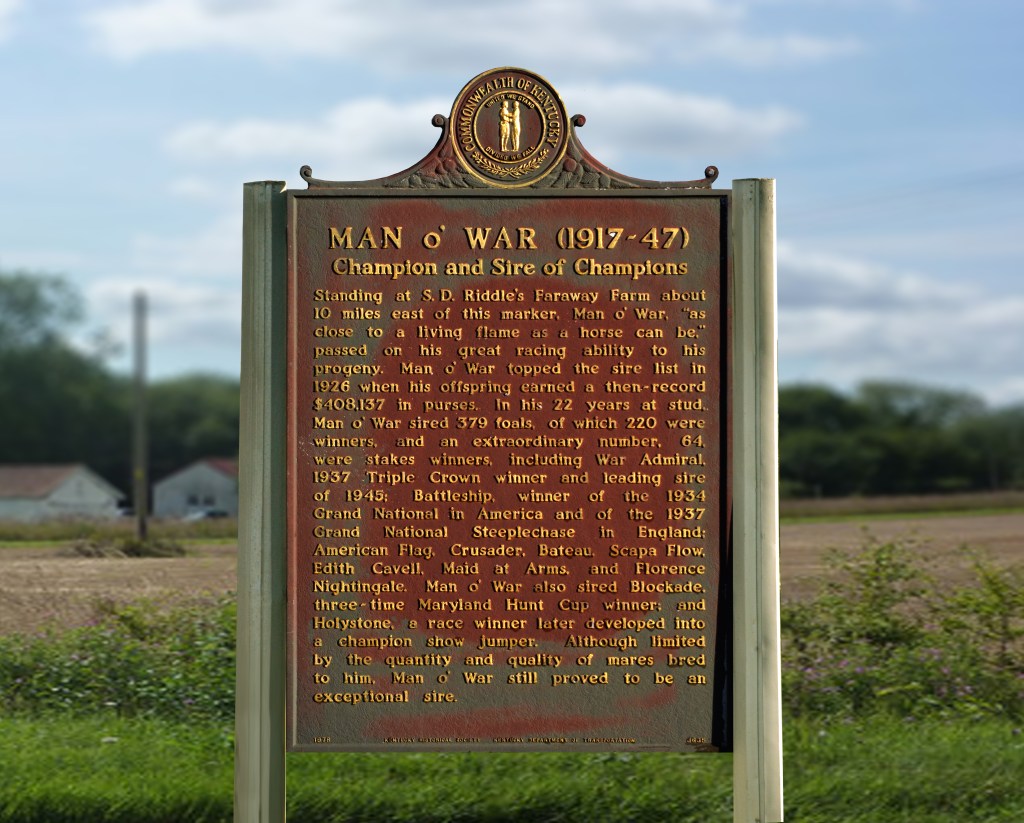
“MAN O’ WAR (1917–47)”
Champion and Sire of Champions
Standing at S. D. Riddle’s Faraway Farm about 10 miles east of this marker, Man o’ War, “as close to a living flame as a horse can be,” passed on his great racing ability to his progeny.Kentucky Historical Society, Marker No. 1635, reverse side
The marker’s reverse side covers his second career, and it may be the more consequential of the two. Retired to Riddle’s Faraway Farm, Man o’ War stood at stud from 1921 until 1943, when a heart condition ended his breeding career and he lived out his remaining years as a pensioner. He topped the North American sire list in 1926, and over 22 years covered 379 foals, of which 220 won races and 64 — an unusually high proportion — won stakes races. The marker names War Admiral, the 1937 Triple Crown winner, as his most famous son, but the reach went further: War Admiral’s own rival, Seabiscuit, descended from Man o’ War through his sire Hard Tack, meaning the two most legendary rivals of Depression-era racing both trace back to the same chestnut stallion standing in a Kentucky paddock.
The Most Visited Horse in America
What the plaque text doesn’t capture, because it isn’t really about racing statistics, is just how famous Man o’ War became simply by standing in a field. Between his retirement in 1921 and his death in 1947, an estimated one to three million people made the trip to Faraway Farm to see him — more, by some estimates, than visited Mammoth Cave, then Kentucky’s other marquee attraction. For much of that stretch his groom, Will Harbut, narrated the horse’s life story to visitors so often and so well that Harbut became something of a celebrity in his own right, closing every telling with the same line: “the mostest hoss there ever was.”
Harbut died in early October 1947. Man o’ War, then thirty years old, died less than a month later, on November 1, of a heart attack — not long enough after his groom’s death for people to resist calling it a broken heart, whatever the biology actually was. His body was embalmed, reportedly the first time that had been done for a horse, and laid in an open casket for more than two thousand mourners over two days. The funeral, on November 4, was broadcast on national radio and included nine eulogies; parked cars lined Huffman Mill Pike for nearly a mile. The U.S. Army’s First Cavalry Division, which had given him the honorary rank of colonel, sent a memorial scroll. He was buried at Faraway Farm beneath a bronze statue by sculptor Herbert Haseltine, inscribed with nothing but his name.
Two Markers for One Horse
If you go looking for Man o’ War today, you’ll actually find two separate Kentucky historical markers, and it’s worth knowing how they divide the story. This one, #1635, stands near his birthplace and tells the racing career. The other, #1215, stands at the Kentucky Horse Park, where his grave and Haseltine’s statue were relocated in 1977 — his remains and the three-thousand-pound bronze moved together, more than three decades after his original burial at Faraway Farm. That marker, dedicated in 1968 and presented by the Thoroughbred Club of America, covers the same ground from the other end: not where he was born, but where he’s laid to rest.
Sources consulted: Kentucky Historical Society / ExploreKYHistory; National Museum of Racing and Hall of Fame; Kentucky Horse Park; Keeneland Library digital collections; Thoroughbred Daily News; Saratoga Living.


I’m eager to hear what you think