recent posts
- Marker No. 1466: Dr. Luke P. Blackburn, the Good Samaritan and the Yellow Fever Trunks
- Marker No. 2568: Joyland Park, Rollercoasters, Dancing, and Picnics on Paris Pike
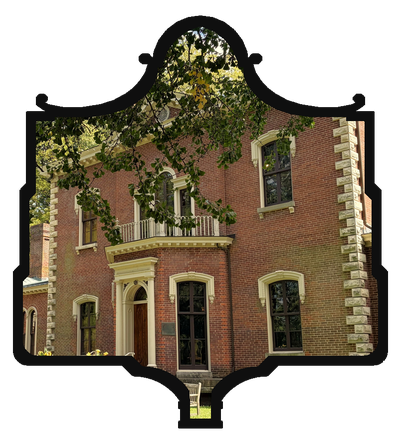
- Marker No. 2174: Pope Villa, and the House That Hid Its Own Story
- Reformers, Firsts, and the Cemetery’s Silences
- Statesmen, Soldiers, and Lexington Fame
about
Category: Historical Markers
-
Dr. Luke P. Blackburn Correctional ComplexOriginally Kentucky Village, this complex renamed in honor of Dr. Luke P. Blackburn, 26th Governor of Ky., in recognition of his pioneer efforts in prison reform. Elected Governor in 1879, after campaigning to relieve conditions at Frankfort Penitentiary, he asked for drastic changes in penal system in first message to…
-
Joyland Park, Paris Pike, 1923‑64 Home of the Wildcat rollercoaster, Joyland Railroad, a midway, Fayette Co.’s first public swimming pool & a dance casino featuring jazz and big bands like Duke Ellington & Artie Shaw, as well as local & regional entertainers. The segregated park provided picnic areas, July 4th fireworks & fun for many…
-
THE POPE VILLA (1811-13)Built for Senator John and Eliza Pope. Designed by B. H. Latrobe (1764-1820), father of American architectural profession and designer to Thomas Jefferson. The Pope Villa has hidden first-story services, with rotunda and major rooms on second story. Latrobe’s most innovative surviving house. Restoration after a fire in 1987. Given by Blue…
-
A companion article to Marker No. 1550: Lexington Cemetery. This is the second of two companion articles built around Marker No. 1550. The first, Statesmen, Soldiers, and Lexington Fame, covered the politicians and generals whose names dominate the cemetery’s own tours. This one turns to the women who built parallel legacies here, in medicine, suffrage,…
-
A companion article to Marker No. 1550: Lexington Cemetery. Lexington Cemetery holds more than 64,000 burials on its 170 rolling acres, and a walk through it doubles as a walk through the city’s identity, at least the version it chose to carve in stone. This is the first of two companion articles built around Marker…
-
A City Outgrows Its Graveyards By the 1840s, Lexington had a burial problem. The city’s older graveyards, small church plots and a scattering of family burial grounds, were overcrowded, and two waves of cholera in the 1820s and ‘30s had left them fuller still. On February 5, 1848, the Kentucky General Assembly chartered the Lexington…
-
A Refuge on Boone’s Creek By 1774, Daniel Boone had already blazed the Wilderness Road and helped found Boonesborough, but he’d grown tired of how crowded that settlement had become. When he surveyed the future station site that year, on a level rise above a spring feeding into Boone’s Creek, he had his eye on…
-
“Halley Field, Lexington’s first municipal airport, was located on Meadowthorpe Farm, owned at the time by Dr. Samuel Halley. In use since 1921, it officially opened May 28, 1927 and was dedicated June 11 of that same year. World-famous aviator Col. Charles Lindbergh landed here on March 28, 1928. Over.” (Reverse) “Halley Field hosted air…
-
A companion to Marker No. 1033: Eastern State Hospital In January 2011, a construction crew preparing the old Eastern State Hospital campus for a new community college building found what a backhoe operator had first stumbled onto back in 2005: unmarked graves, far more of them than anyone expected, quietly holding at least 186 people…
-
A school named for the Great Emancipator, partly funded by his own son, opened in Irishtown in 1912 — and did not allow admission to Black children for the entirety of its fifty-five years as a public school. A companion piece to the Madeline McDowell Breckinridge article.

