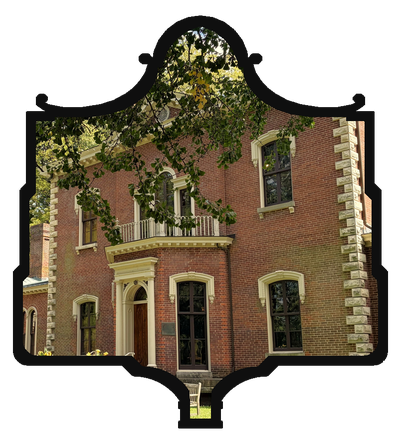
Joyland Park, Paris Pike, 1923‑64
Home of the Wildcat rollercoaster, Joyland Railroad, a midway, Fayette Co.’s first public swimming pool & a dance casino featuring jazz and big bands like Duke Ellington & Artie Shaw, as well as local & regional entertainers. The segregated park provided picnic areas, July 4th fireworks & fun for many children.
Joyland Neighborhood Association
Kentucky Historical Society, Marker No. 2568 — erected 2019
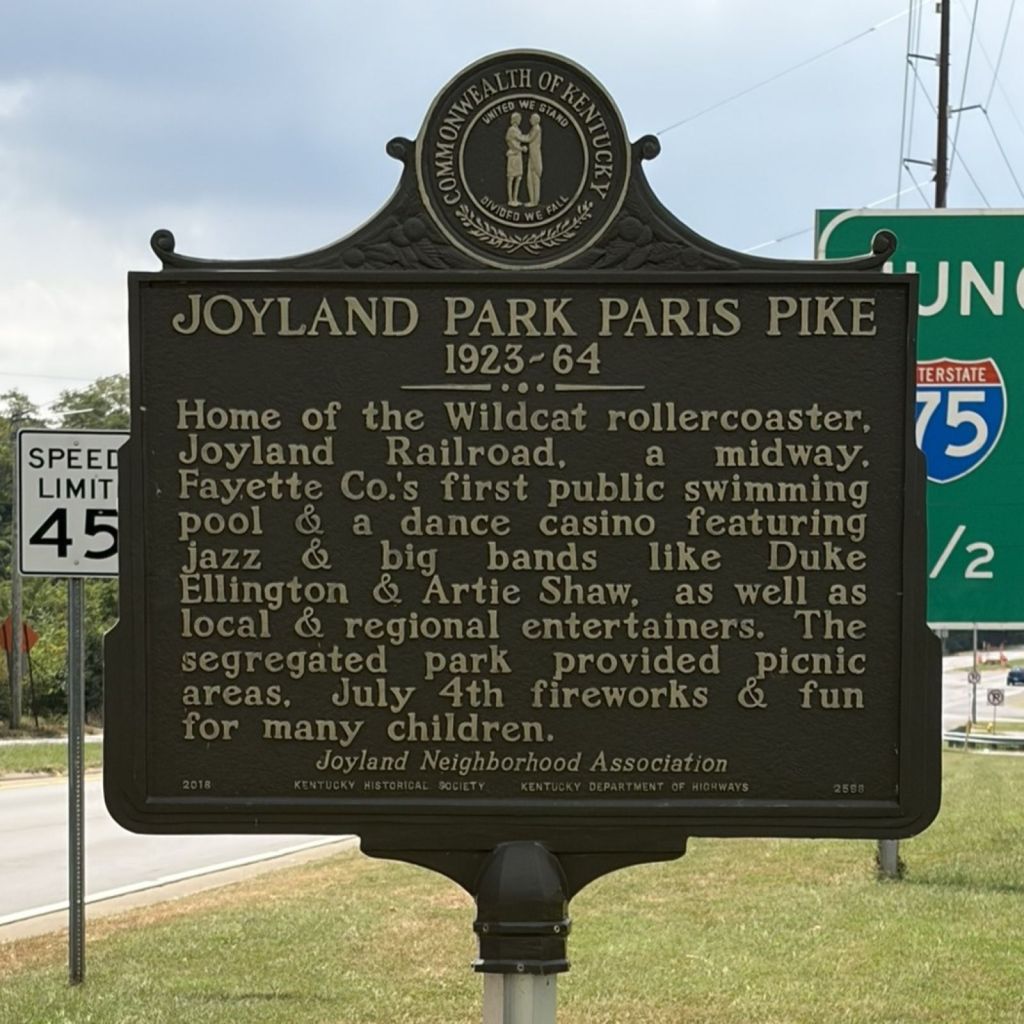
2375 Paris Pike, Lexington, KY 40505 | 38°4′49″N, 84°26′54″W — Directions: MapQuest
A Roaring Twenties Idea
Joyland opened on May 30, 1923, on the north side of Lexington, along what was then a fairly open stretch of Paris Pike. It wasn’t the Sauer family’s first venture into the business: they had already been running Bluegrass Park, an older trolley park off what’s now Versailles Road, since 1909, complete with its own wooden coaster, the Scenic Railway. Joyland was a bigger, more ambitious follow‑up. Frank Brandt handled general management; brothers John W. Sauer and F. Keller Sauer ran the rides. A fourth partner, A. M. James, took charge of the dance hall. Weekday admission to the grounds was free, with rides, games, and food priced separately, a fairly standard amusement‑park arrangement for the era.
The owners softened that a little: Lexington’s orphans were invited in for free rides and games several times a year, and white children could take free swimming lessons at the park pool. The parking lot alone could hold close to five thousand cars, a scale that says something about how far people were willing to drive.
The Wildcat and the Midway
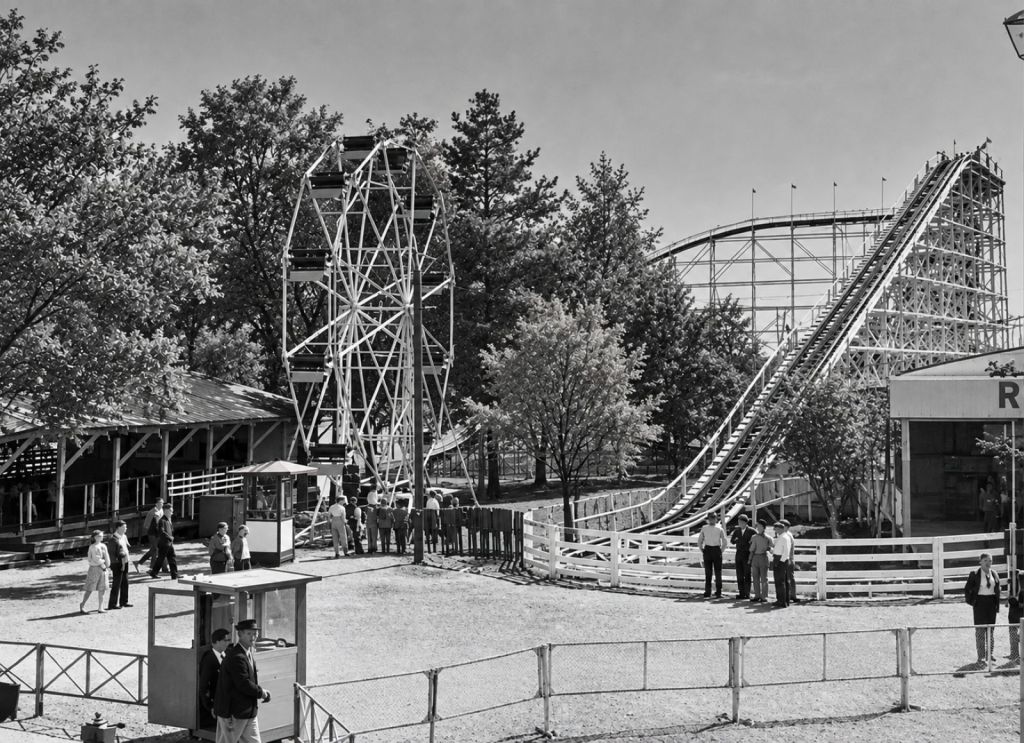
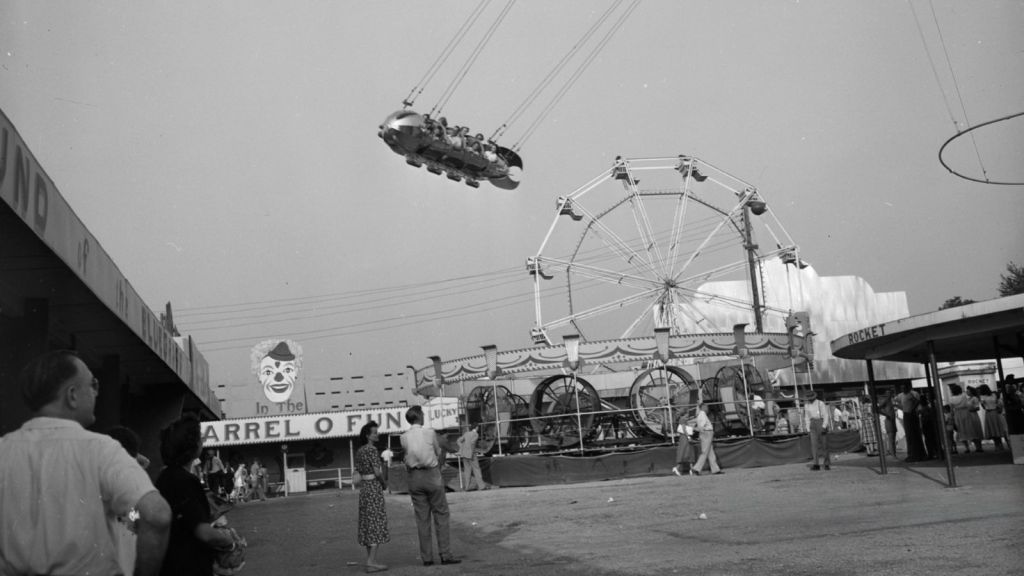
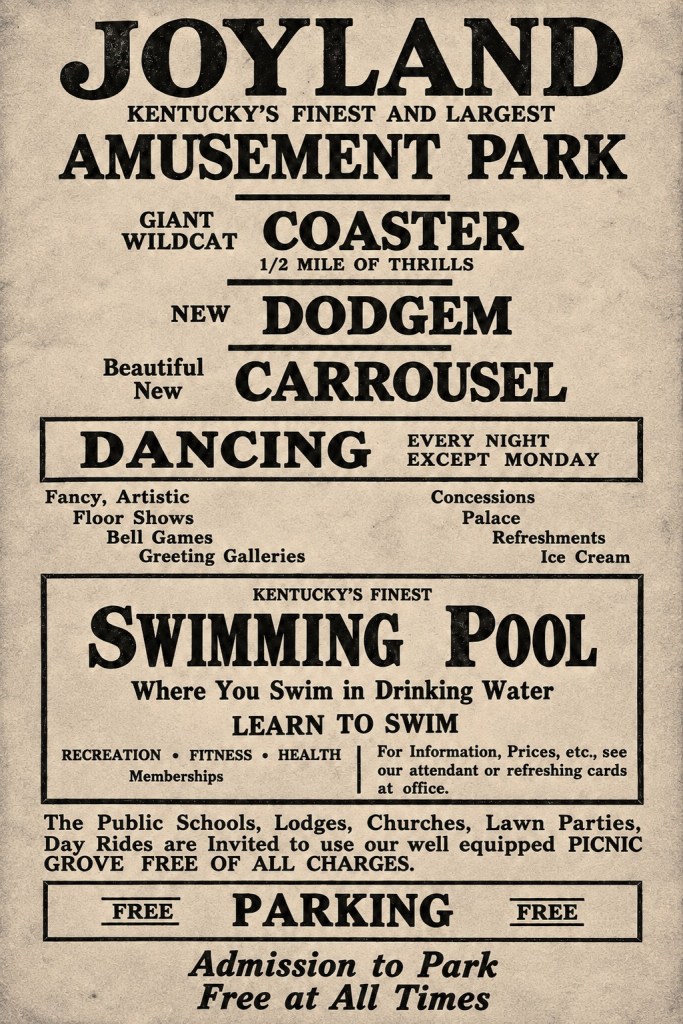
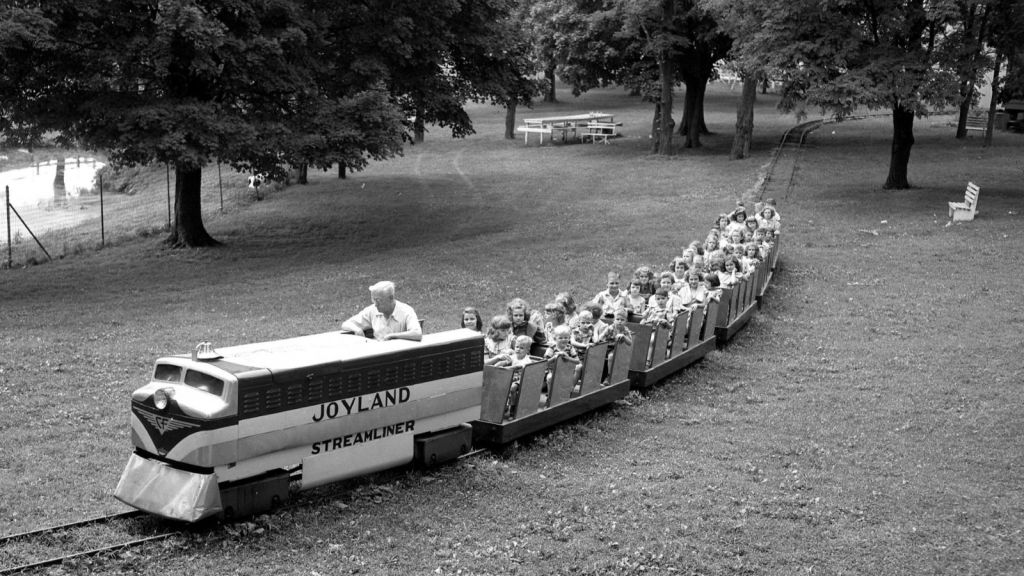
The park’s signature attraction was the Wildcat, a wooden rollercoaster built in the late 1920s by Philadelphia Toboggan Coasters, Inc., a manufacturer still in business today and responsible for some of the country’s most historically significant wooden coasters and carousels. An undated, unverified period advertisement billed it as “½ mile of thrills.” Despite the marker’s singular billing, Joyland actually ran two coasters: the Wildcat and a smaller Kiddie Coaster alongside it. The rest of the midway filled in around them: a miniature railroad known as the Joyland Streamliner, a funhouse (called Barrel O’ Fun as of 1948, later Laff in the Dark by the 1950s), a swing ride called The Rocket, bumper cars, a carousel, pony rides, arcade games, a playground for children waiting their turn, and ball fields that hosted local leagues and visiting teams from other towns. Joyland also kept a small zoo, an odd but common feature of period amusement parks, with a bear, a monkey, a wolf, an alligator, and an anteater among the residents.
The pool was the real civic milestone: it was Fayette County’s first public swimming pool, at a time when most swimming in the county still meant a creek or a private club. That same unverified advertisement touts it as filled with “drinking water,” a sanitary selling point of the era, and names a Stella Spicer as swim instructor, though neither detail has turned up anywhere else and should be read as color rather than confirmed fact.
The park also served as an occasional stage for university life. In July 1945, the Kentucky Kernel reported that Joyland would host a “UK Day” for University of Kentucky faculty, staff, and students, tied to a fundraising push for the McVey Scholarship Fund, a small window into how thoroughly the park had woven itself into the lives of Lexingtonians by the mid‑1940s.
Club Joy and the Big Bands
The Club Joy Dance and Casino was Joyland’s evening identity. Despite the name, there’s no confirmed record of gambling machines on site, though rumors of something happening behind closed doors persisted without ever producing charges. What’s better documented is the music: cover charges ran 50¢ on weeknights and 75¢ on weekends, and the club booked touring acts alongside its house orchestra. Duke Ellington and Artie Shaw both played there, and Club Joy’s regulars, The Bluegrass Troubadours and Smoke Richardson and his Orchestra, filled out most other nights. Dancing reportedly ran “every night except Sunday.”
Some acts reportedly went out live over the radio. If Club Joy’s shows really did air in the 1930s, the likeliest carrier was WLAP, Lexington’s only established station through that decade and into the ’40s, having relocated from Louisville in March 1934.
For a stretch in the 1930s, Club Joy also hosted a “Miss Kentucky” beauty contest. The timing fits a national pattern: after the Miss America pageant’s own mid‑decade hiatus and 1933 revival, amusement parks, swimming pools, and theaters across the country became common local hosts for beauty contests riding on its popularity. Whether Club Joy’s version had any formal tie to the Miss America pageant isn’t clear from the surviving record. It may just as easily have been one of many locally run contests borrowing a familiar name, a common and largely undocumented practice at the time.
A Segregated Kind of Fun
The marker’s own wording, “the segregated park,” is doing real work, and it’s worth considering rather than passing. Joyland operated as a whites‑only venue by default. Black families were let in only on designated “special” days set aside for that purpose, and Black children were barred from the pool outright.
When the Lexington Leader ran its free learn‑to‑swim program, white children took their lessons at Joyland; Black children were routed to Douglass Park’s pool instead, a parallel but separate facility on the other side of town. The program kept running at Joyland right up until the park’s last years: in 1961, just two years before closing, 705 girls enrolled and 226 earned their beginner swimming certification, a record for the program.
Even the touring Black musicians who played Club Joy’s stage performed to a room they weren’t otherwise welcome to sit in. None of this made Joyland unusual. It reflected how public leisure in Lexington was organized for most of the twentieth century, part of a segregated park system that included places like Bluegrass Park and dated back to at least 1916.
Decline and the Final Curtain
The Sauer family, who also owned Bluegrass Park, sold Joyland in 1942 to a trio of new owners: Garvice Kincaid, M. C. Haddix, and Carl King, per University of Kentucky Special Collections records. Kincaid is the one name here with a documented afterlife. He went on to become one of postwar Kentucky’s most significant businessmen, the state’s youngest bank president at 32 years old in 1945, later the owner of Kentucky Central Life Insurance and the developer behind downtown Lexington’s Kincaid Towers, and by his death in 1975 the head of an empire estimated near $500 million. In 1942, none of that had happened yet; buying into a Paris Pike amusement park was one of his earliest capital ventures, years before the bank presidency or the insurance company. Haddix and King left no comparable trace in the record.
The 1950s decline, thinning attendance, sections closing one at a time, competition from television, movie theaters, and larger regional parks, played out entirely under the Kincaid ownership group. By August 1963, the losses had piled up enough that the park shut down entirely.
Fire, Bulldozers, and What Came After
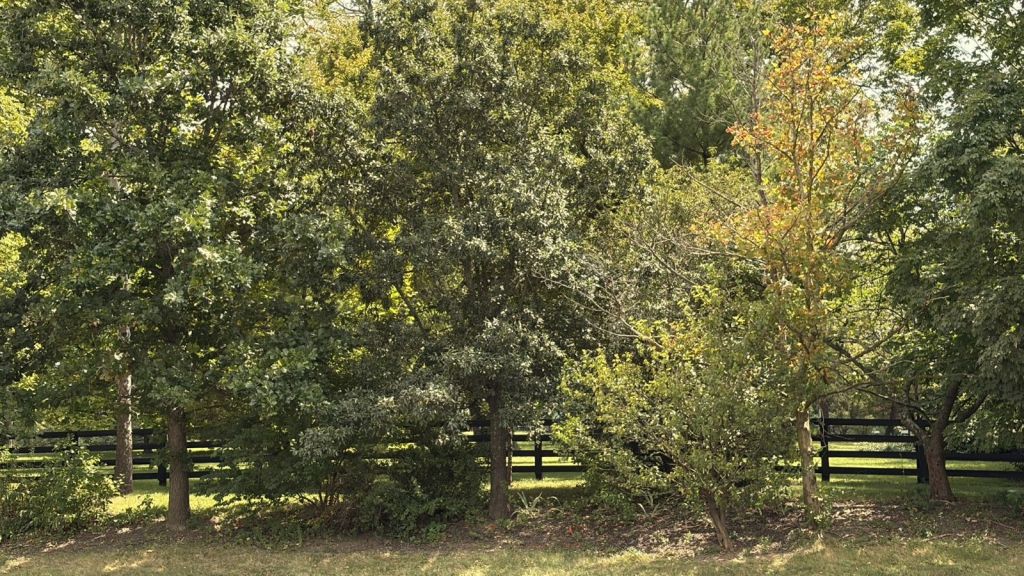
Club Joy burned in a fire that gutted the building beyond repair. Some accounts date the fire to 1964; a surviving Kentucky Photo Archives photograph is captioned 1965. Either way, the building burned within a year or two of the park’s closing and was torn down soon after. Developers bought the land, cleared what remained, and built Mary Todd Elementary School and the Joyland Bowling Alley, which operated into the early 2000s. A residential subdivision went up around them and took the old park’s name: Joyland, the neighborhood that still carries it on the map, sits on the ground where the Wildcat once ran.
Sources consulted: Kentucky Historical Society marker inscription (No. 2568, erected 2019); Kurt Robinson, “Joyland Park,” ExploreKYHistory; Historical Marker Database (hmdb.org); Roller Coaster Database (rcdb.com); University of Kentucky Special Collections Research Center, David Hooden photographs of Joyland finding aid; Kentucky Photo Archive; Kentucky Kernel, June 29, 1945; Joyland Neighborhood Association marker dedication record, April 2019.



I’m eager to hear what you think