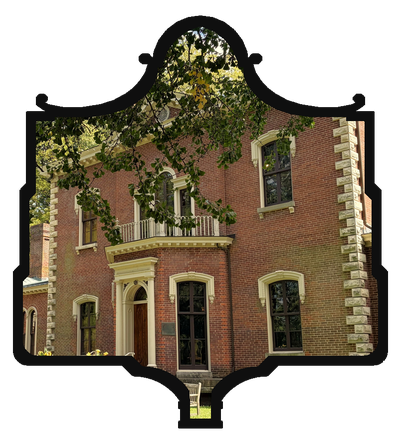
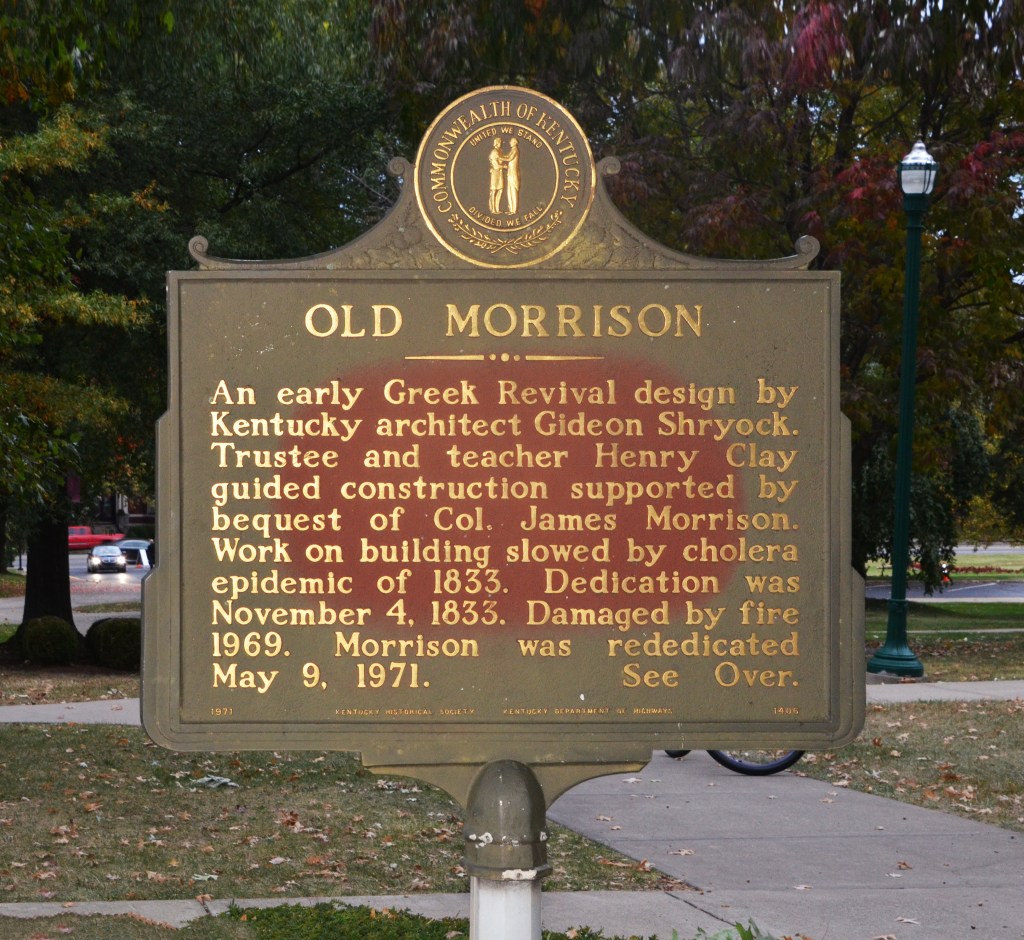
“OLD MORRISON”
An early Greek Revival design by Kentucky architect Gideon Shryock. Trustee and teacher Henry Clay guided construction supported by bequest of Col. James Morrison. Work on building slowed by cholera epidemic of 1833. Dedication was Nov. 4, 1833. Damaged by fire 1969. Morrison was rededicated May 9, 1971.Kentucky Historical Society, Marker No. 1406
Transylvania University campus, 3rd Street, Lexington, Kentucky | approx. 38° 3′ 4″ N, 84° 29′ 39″ W — Directions: MapQuest
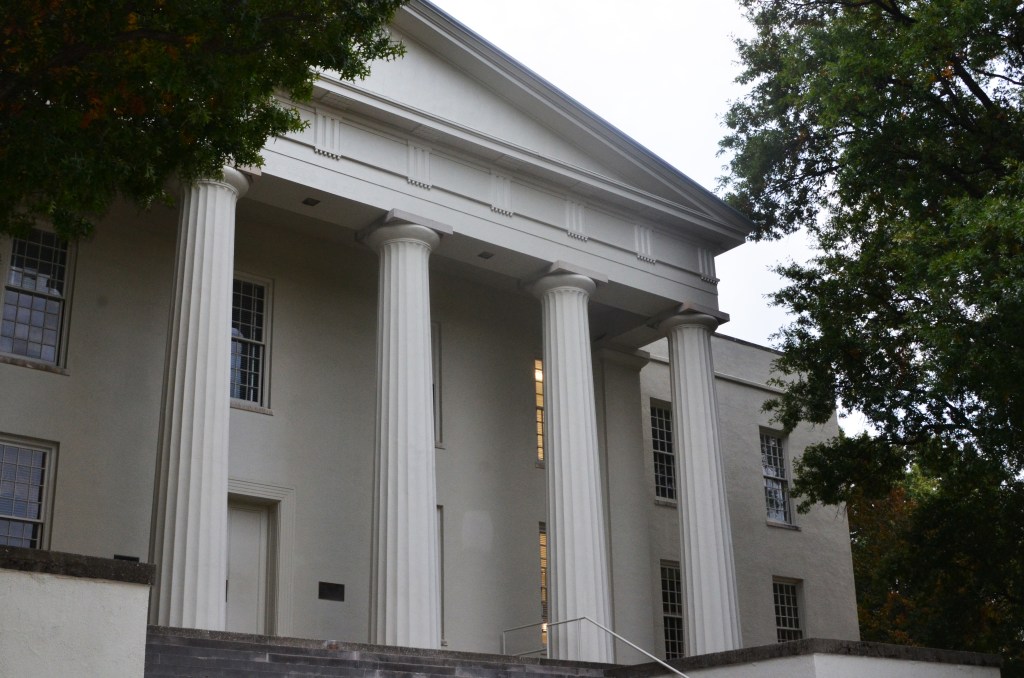
Most of the markers in this book point to something that used to be somewhere — a house long gone, a farm turned into a research park, a marker for a marker. Old Morrison is different. Walk onto Transylvania University’s campus today and the building the plaque describes is still standing, still in daily use, its six Doric columns still visible from blocks away. It’s also a building that Henry Clay quite literally built, not with his own hands, but with his own judgment, at a moment when the university needed exactly that.
A Second Building, After a Fire
Old Morrison is technically Transylvania’s second main building, not its first. The university’s original 1818 classroom building burned in 1829, a loss serious enough that it briefly displaced the whole institution while trustees figured out what to do next. Henry Clay, who taught law at Transylvania and sat on its board, took the lead in guiding the replacement, not as an architect, but as the trustee steering the project, choosing the design, and keeping it moving. For the actual design, the board turned to Gideon Shryock, a young Kentucky architect who’d just finished the Old State Capitol in Frankfort and was quickly becoming the state’s leading name in Greek Revival work. Shryock would go on to design Arkansas’s state capitol as well; Old Morrison was, in a sense, his hometown masterpiece.
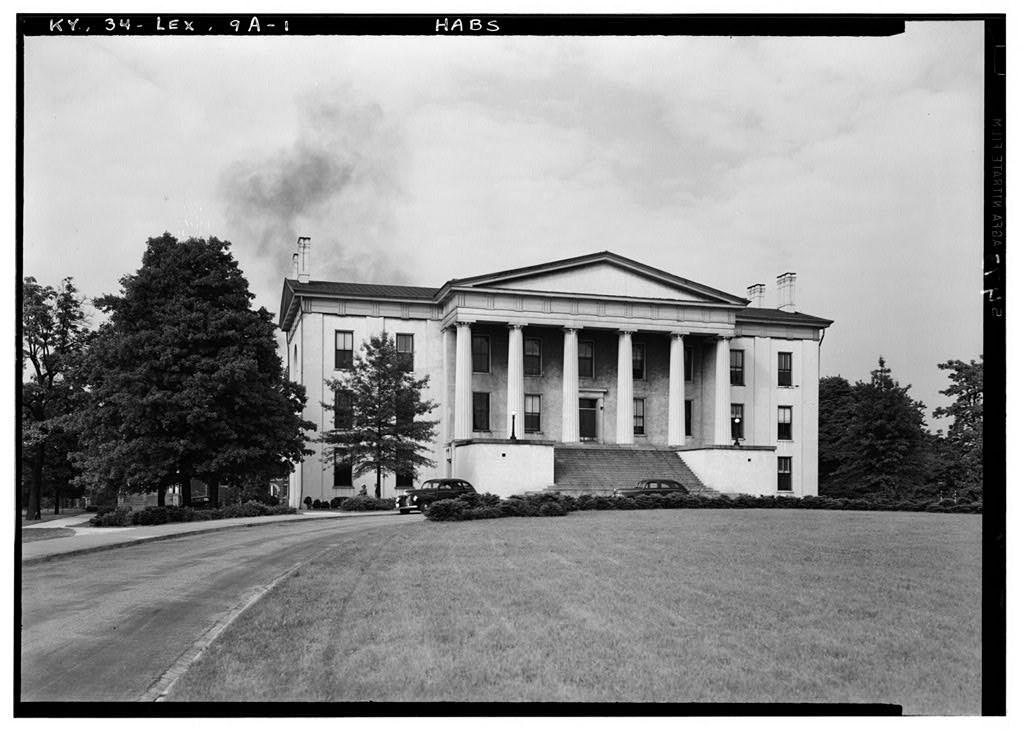
Old Morrison, photographed in 1933 by the Historic American Buildings Survey — 36 years before the fire that gutted its interior. Library of Congress, HABS KY-61.
The funding came from Colonel James Morrison, a wealthy Lexington trustee and Revolutionary War veteran whose estate, handled by Clay as executor, provided roughly $30,000 toward the new building, enough to give it his name once it was finished. Construction ran from 1830 to 1834, and it wasn’t an easy stretch: the cholera epidemic that swept Lexington in the summer of 1833 slowed the work considerably, killing hundreds across the city and disrupting daily life in the middle of the project. The building was dedicated that November regardless, even though finishing touches continued into the following year.
Both Sides of a Divided Country
“TRANSYLVANIA ALUMNI,” reverse
Jefferson Davis, John Hunt Morgan, Stephen F. Austin, Cassius M. Clay, Albert Sidney Johnston, James Lane Allen and John Fox, Jr. were students here. Among past Transylvanians are two U.S. Vice-Presidents — Richard M. Johnson and John C. Breckinridge — 50 U.S. Senators, 101 Representatives, three House Speakers, 36 Governors, and 34 Ambassadors.Kentucky Historical Society, Marker No. 1406, reverse side
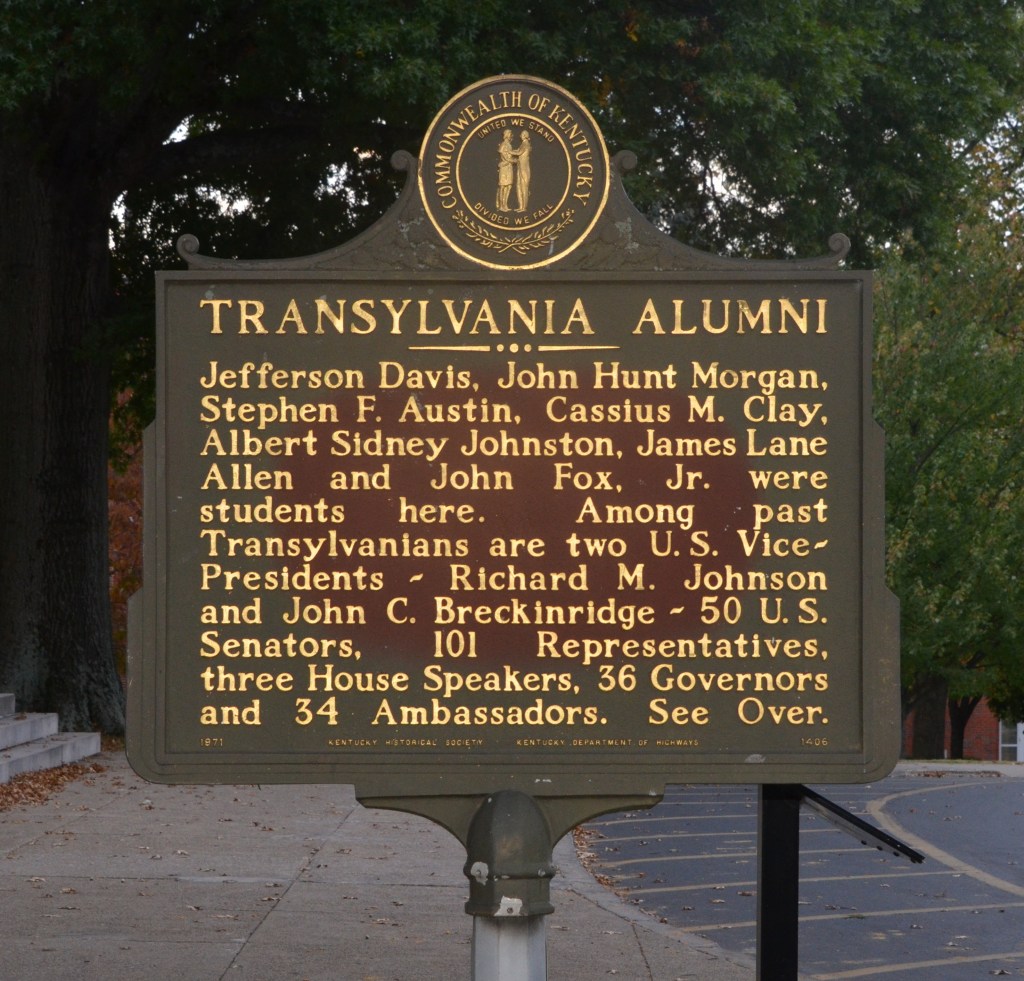
The reverse side reads like a résumé the university is proud of, and by most measures it’s earned the bragging rights, two vice presidents, dozens of senators and governors, a genuinely remarkable output for a small liberal arts college. But read the alumni list slowly and it starts to look less like a list of achievements and more like a photograph of a country about to tear itself apart. Jefferson Davis, who would become president of the Confederacy, studied here. So did Albert Sidney Johnston, who became a Confederate general and died at Shiloh. So did John Hunt Morgan, the Confederate cavalry raider whose own house is another marker in this project. And so, in the very same building, on the very same list, did Cassius Marcellus Clay, a Kentucky emancipationist so committed to abolition that he armed his newspaper office against pro-slavery mobs and later served as Lincoln’s minister to Russia. Transylvania didn’t produce one side of the Civil War. It produced both, sitting in the same lecture halls a few years apart.
The “first college west of the Alleghenies” claim on Transylvania’s own promotion literature is worth a small footnote too: it’s a point of real local pride, but it’s also the kind of superlative several early frontier institutions claimed for themselves, and historians of higher education generally treat “first” claims from this era as more a matter of self-branding than settled fact. What’s not in dispute is that Transylvania, chartered in 1780 and operating continuously since, is genuinely one of the oldest institutions of higher education in the country west of the original colonies, which is remarkable enough.
A Curse, a Tomb, and a Fire
No account of Old Morrison is complete without Constantine Rafinesque, and the marker doesn’t mention him at all. Rafinesque was a genuinely brilliant, genuinely difficult naturalist who taught botany at Transylvania in the 1820s, until university president Horace Holley fired him, officially for erratic conduct, though campus legend has long preferred a rumor involving Holley’s wife. As the story goes, Rafinesque cursed the university on his way out. Holley died of yellow fever not long after. The original building burned in 1829. And when the crumbling remains of Rafinesque’s own grave in Philadelphia were rediscovered in 1924, Transylvania brought what were believed to be his bones home and entombed them beneath Old Morrison’s front steps, partly as an honor, and partly, students have always suspected, as an attempt to stop the curse.
It didn’t, or at least the story goes that it didn’t: in January 1969, a fire tore through Old Morrison and gutted most of its interior, leaving little but the exterior walls standing. The one part of the building the fire didn’t touch, according to accounts from that night, was Rafinesque’s tomb. Whether or not you put any stock in a curse with a taste for irony, the practical result was a two-year restoration that rebuilt the interior essentially from scratch while preserving Shryock’s original exterior design, and the building was rededicated in May 1971, the event this very marker was erected to commemorate. Modern testing has actually cast some doubt on whether the remains under the steps are Rafinesque’s at all, rather than those of a woman originally buried alongside him in Philadelphia. Transylvania has kept the tomb, and the tradition, regardless: every Halloween, students still enter a raffle for the chance to spend the night sleeping beside it.
Still the Face of the Campus
Old Morrison never really stopped being the center of Transylvania’s identity. It served as a Civil War hospital for both Union and Confederate forces at different points in the same conflict its own alumni had helped start. It’s been an administration building, an academic hall, and a chapel, sometimes all at once. Its silhouette is prominent enough that it has appeared as the central image on the official seal of the City of Lexington, a Greek Revival portico standing in for the whole city, not just the campus it sits on. Today it houses the university’s president, deans, and administrative offices, and every autumn its front steps disappear under hundreds of carved pumpkins for Transylvania’s Pumpkinmania, a tradition that turns Rafinesque’s supposedly cursed doorstep into one of the more cheerful sights in Lexington each October.
Sources consulted: Kentucky Historical Society / ExploreKYHistory; SAH Archipedia; Transylvania University; Gratz Park Neighborhood Association; Historical Marker Database (hmdb.org); Wikipedia.



I’m eager to hear what you think