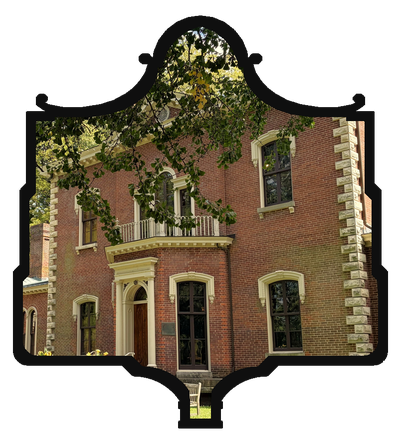
“VERTNER WOODSON TANDY, 1885-1949”
Born in Lexington, son of Henry A. Tandy, respected African American contractor. Attended the Chandler School, Tuskegee Institute, Cornell Univ. 1st registered black architect in New York State, where he built landmark homes & buildings. A founder of Alpha Phi Alpha, the oldest African American fraternity.Sponsored by Alpha Phi Alpha Fraternity, Inc., Alpha Beta Lambda Chapter, Lexington, Ky. — Kentucky Historical Society, Marker No. 2296
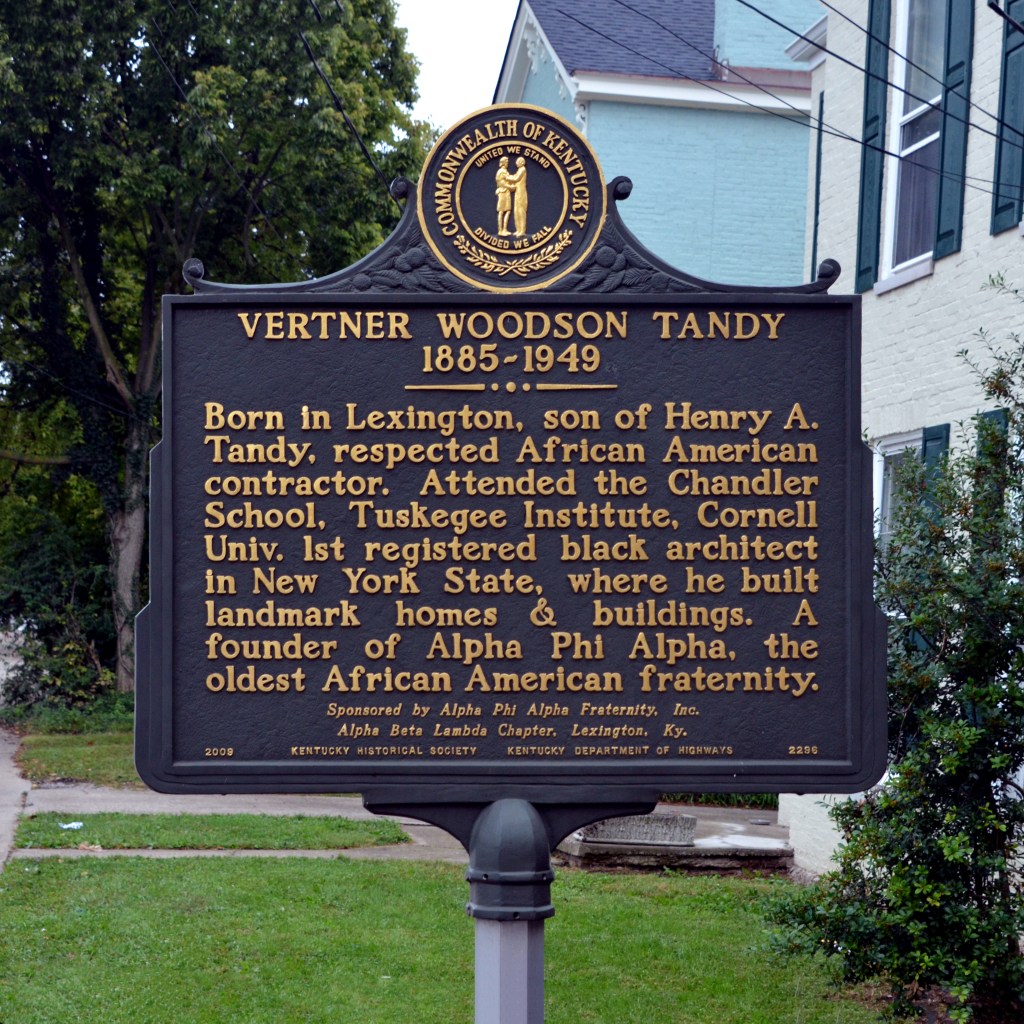
642 West Main Street, Lexington, Kentucky | 38° 3′ 9″ N, 84° 30′ 14″ W — Directions: MapQuest
Most markers in this site point back at Lexington, a house, a farm, a building still standing on the spot. This one points outward. Vertner Tandy left Kentucky as a young man and never really came back, and his most famous work stands 750 miles away on a hillside above the Hudson River. But the marker is right to claim him, because everything that made that career possible, the discipline, the trade knowledge, the sheer nerve it took to become the first at something, started on this street, watching his father run a construction crew.
A Father Born Enslaved, Building Lexington’s Skyline
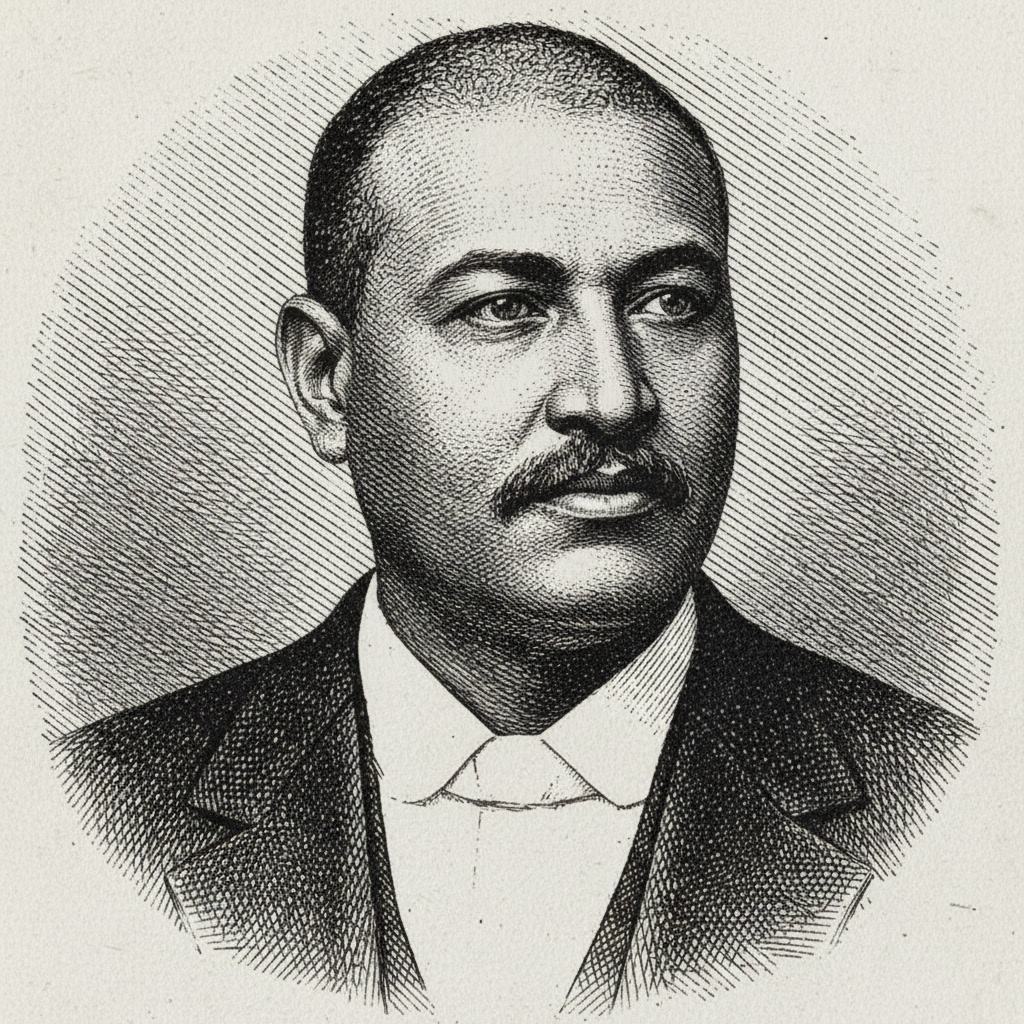
Henry A. Tandy was born enslaved in Estill County around 1853 and came out of the Civil War with, effectively, nothing but a trade. He built it into one of the more remarkable business stories in nineteenth-century Kentucky. By 1893 he’d established his own firm, Tandy & Byrd, specializing in decorative stonework and brickmasonry, and within a couple of decades that firm’s work was all over downtown Lexington: the Lexington Opera House, the Fayette County Courthouse, and other buildings whose brick and stone still stand today, even if most passersby have no idea who laid it. By the time he died in 1918, Henry Tandy was among the wealthiest Black Kentuckians of his era, a fact made more remarkable, by how his own life had begun.
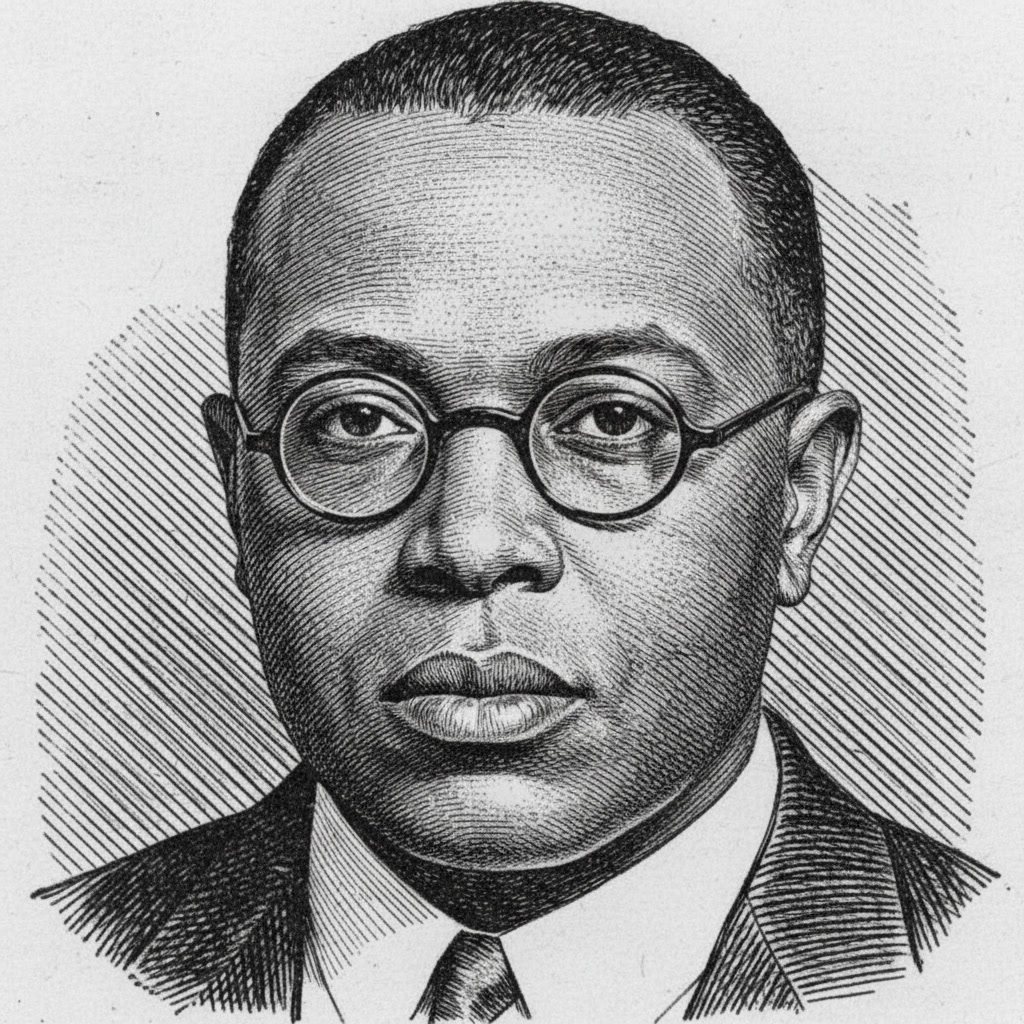
Vertner, born in 1885, grew up watching his father’s business run. The marker’s mention of “the Chandler School” is a nod to his early education in Lexington’s segregated school system, but his real architectural education happened on his father’s job sites, absorbing the trade before he ever opened a textbook on it.
Tuskegee, Then Cornell, Then “The Seven Jewels”
Tandy enrolled at Tuskegee Institute in 1904 to study architectural drawing under Booker T. Washington’s direct influence, and by most accounts quickly became the program’s standout student. A year later, in 1905, he transferred to Cornell University to finish his architecture degree — a significant jump in itself, from a historically Black institution built explicitly around vocational and industrial training to an Ivy League research university where he’d have been one of vanishingly few Black students on campus.
It was at Cornell, in December 1906, that Tandy and six other Black students founded Alpha Phi Alpha, the first intercollegiate Greek-letter fraternity established for Black men in America, and still the oldest one operating today. The seven founders are remembered within the fraternity as “the Seven Jewels.” Tandy served as the chapter’s first treasurer and personally designed the organization’s pin, and he was the one who guided the fraternity through incorporation as it began expanding to other campuses. Alpha Phi Alpha now counts roughly 800 chapters and a membership list that runs through W.E.B. Du Bois, Thurgood Marshall, and Martin Luther King Jr., an organization Tandy helped invent before he’d even finished his degree.
First in New York
Tandy graduated from Cornell and by the time he set up practice in Manhattan, with a partner named George Washington Foster in the firm Tandy & Foster, he had become the first Black architect registered in the state of New York. He would later add a second, quieter first: becoming the first Black member inducted into the American Institute of Architects, the profession’s main national body, at a time when plenty of the profession’s institutions weren’t especially eager to open that door.
Villa Lewaro and the Buildings That Remain
Tandy’s most famous commission, by a wide margin, was Villa Lewaro, the 34-room, 20,000-square-foot Italianate mansion he designed for Madam C.J. Walker, the hair-care entrepreneur widely credited as America’s first self-made female millionaire. Built between 1916 and 1918 on a hillside above the Hudson in Irvington, New York, at a reported cost of $250,000, Villa Lewaro became one of the social and cultural landmarks of the Harlem Renaissance — a place where Walker hosted W.E.B. Du Bois and other leading Black intellectuals and activists of the era. It’s now a National Historic Landmark, and it’s not hard to see why: it was a direct, physical statement that Black wealth and Black achievement belonged on the same hillsides as anyone else’s.
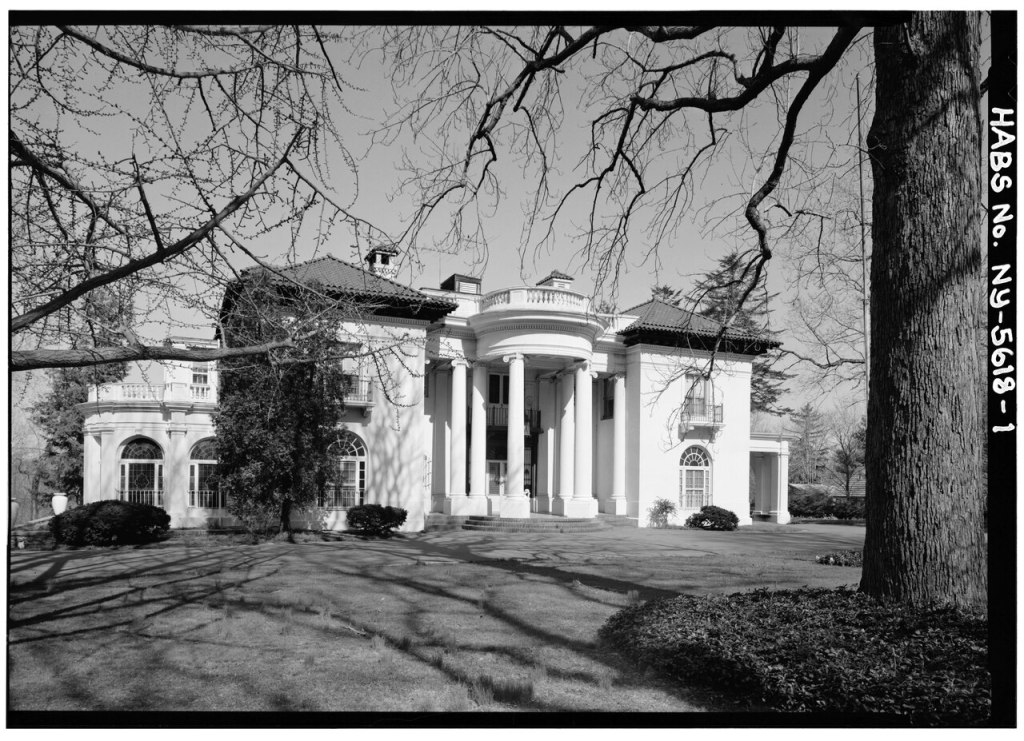
Tandy’s other major surviving work includes St. Philip’s Episcopal Church in Harlem, completed in 1911 when Tandy was still in his twenties, and the Ivey Delph Apartments on Hamilton Terrace, one of his later projects, added to the National Register of Historic Places in 2005. Between them, his buildings trace a career that started designing houses of worship for Harlem’s growing Black congregations and ended designing housing for the neighborhood’s residents, a body of work still standing, still in use, nearly eighty years after his death.
A Soldier, Too
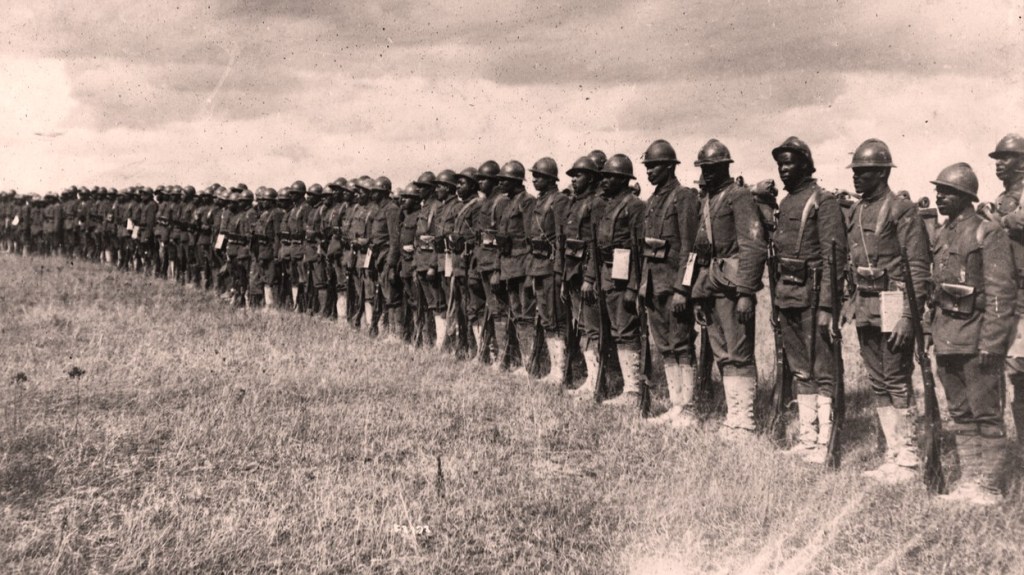
The marker doesn’t mention it, but Tandy also broke a barrier in uniform: he’s credited as the first Black American to pass the military officer’s commissioning examination, and he was commissioned a first lieutenant in the 15th Infantry of the New York State National Guard — the same regiment that would later become famous in combat during World War I as the 369th Infantry, the “Harlem Hellfighters.” It’s a smaller footnote next to Villa Lewaro and Alpha Phi Alpha, but it fits the pattern of a life spent being first through doors that weren’t especially open.
A Park Renamed
Vertner’s father Henry’s own Lexington legacy got a public update in 2020. The city park once known as Cheapside, the same square documented as the site of Lexington’s slave auction block, had stood for decades with statues of Confederate general John Hunt Morgan and Vice President John C. Breckinridge at its center. Following a grassroots campaign called Take Back Cheapside, the statues came down, and the park was renamed Henry A. Tandy Centennial Park, honoring the formerly enslaved man whose stonework built much of downtown Lexington, on the same ground where people like him had once been sold.
Sources consulted: Kentucky Historical Society / ExploreKYHistory; BlackPast.org; Historical Marker Database (hmdb.org); Wikipedia (Vertner Woodson Tandy, Henry A. Tandy, Villa Lewaro); New York Amsterdam News; African American Registry.



I’m eager to hear what you think