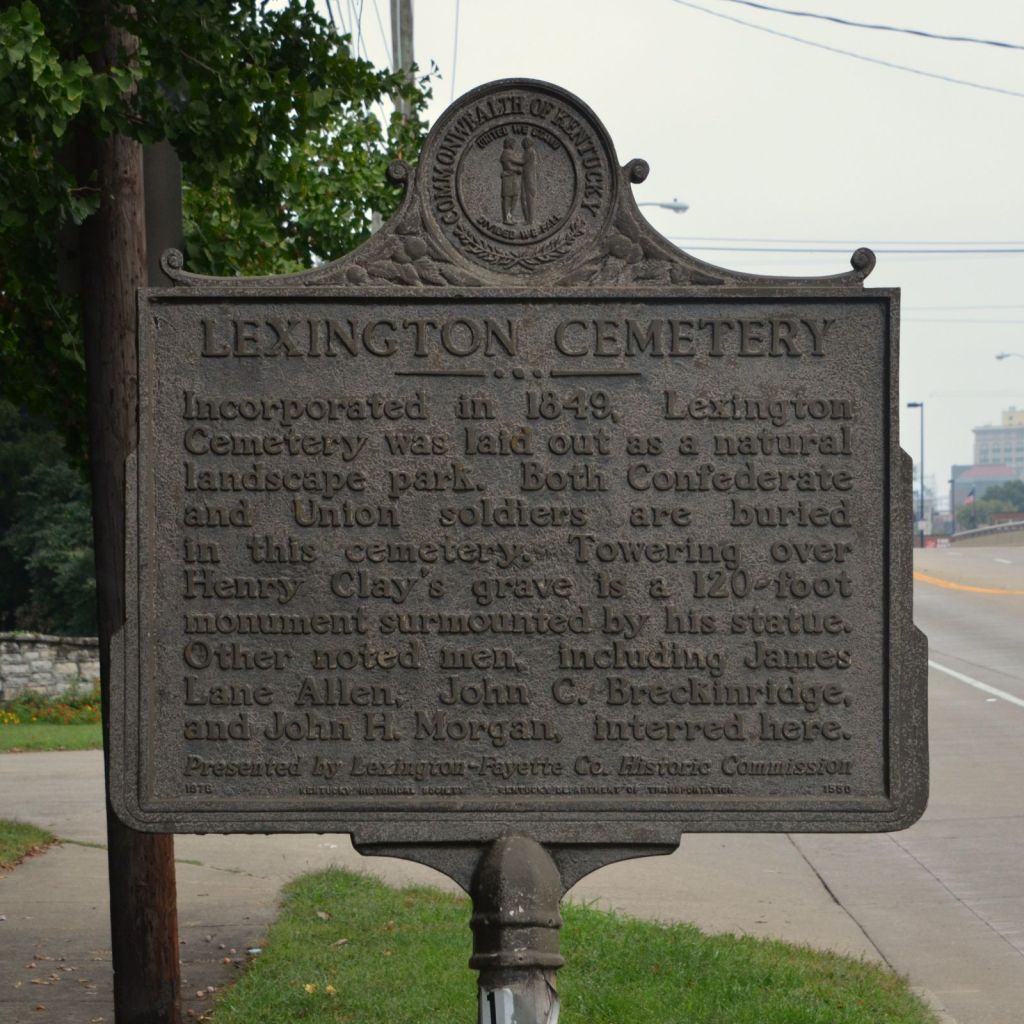
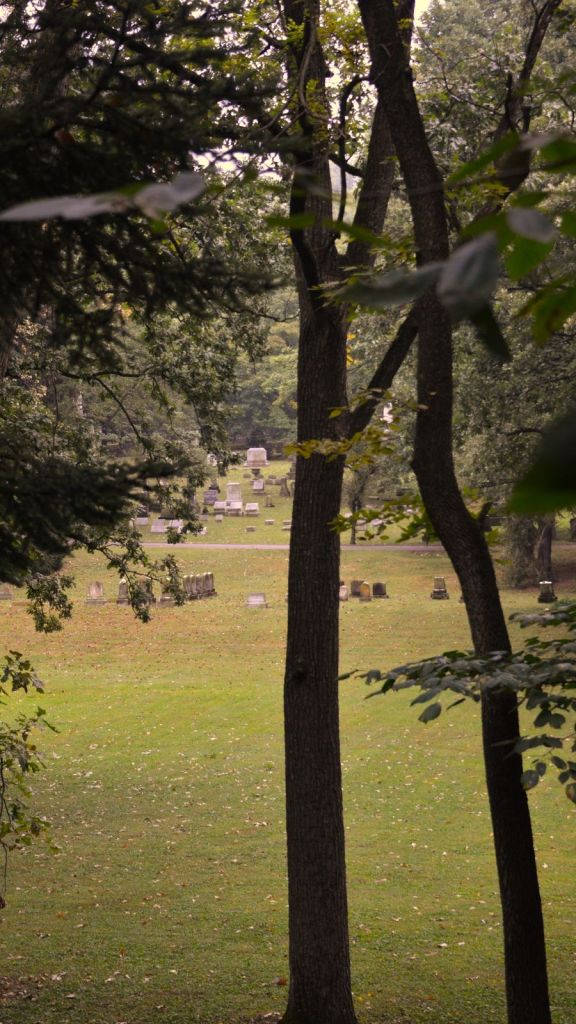
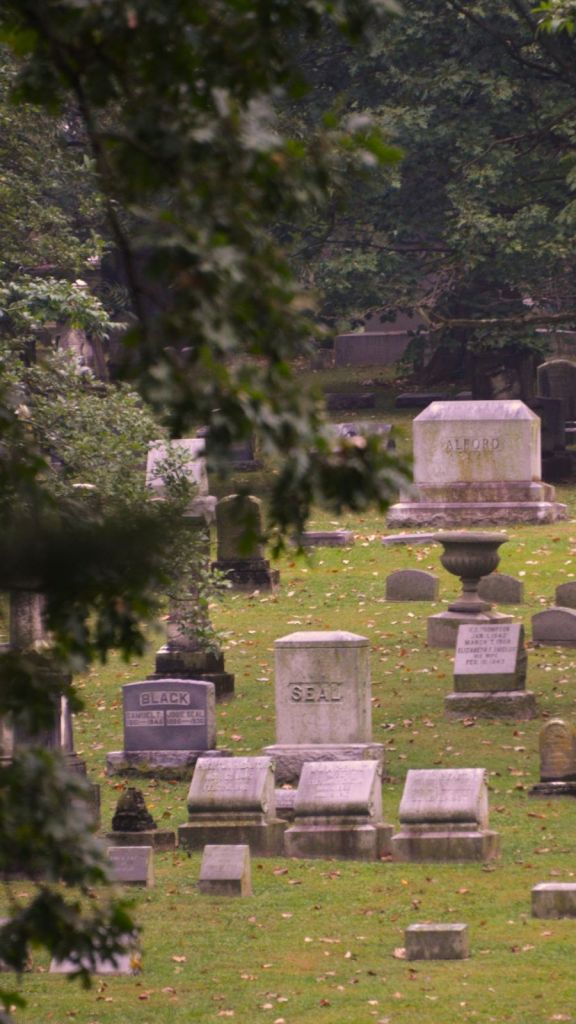
“LEXINGTON CEMETERY” Incorporated in 1849, Lexington Cemetery was laid out as a natural landscape park. Both Confederate and Union soldiers are buried in this cemetery. Towering over Henry Clay’s grave is a 120-foot monument surmounted by his statue. Other noted men, including James Lane Allen, John C. Breckinridge, and John Hunt Morgan, interred here. Presented by Lexington-Fayette Co. Historic Commission.
Location: 833 West Main St. (US 421), Lexington, Fayette County, Kentucky | 38° 3′ 21″ N, 84° 30′ 30″ W — Directions: MapQuest
A City Outgrows Its Graveyards
By the 1840s, Lexington had a burial problem. The city’s older graveyards, small church plots and a scattering of family burial grounds, were overcrowded, and two waves of cholera in the 1820s and ‘30s had left them fuller still. On February 5, 1848, the Kentucky General Assembly chartered the Lexington Cemetery Company at the request of some of the city’s most prominent citizens, Henry Clay and Robert Wickliffe among them, to build something Lexington didn’t yet have: a rural cemetery, in the sense fashionable in that era’s biggest cities. Instead of cramped churchyard rows, planners imagined winding paths, ponds, and specimen trees, a landscape meant to be visited rather than simply used.
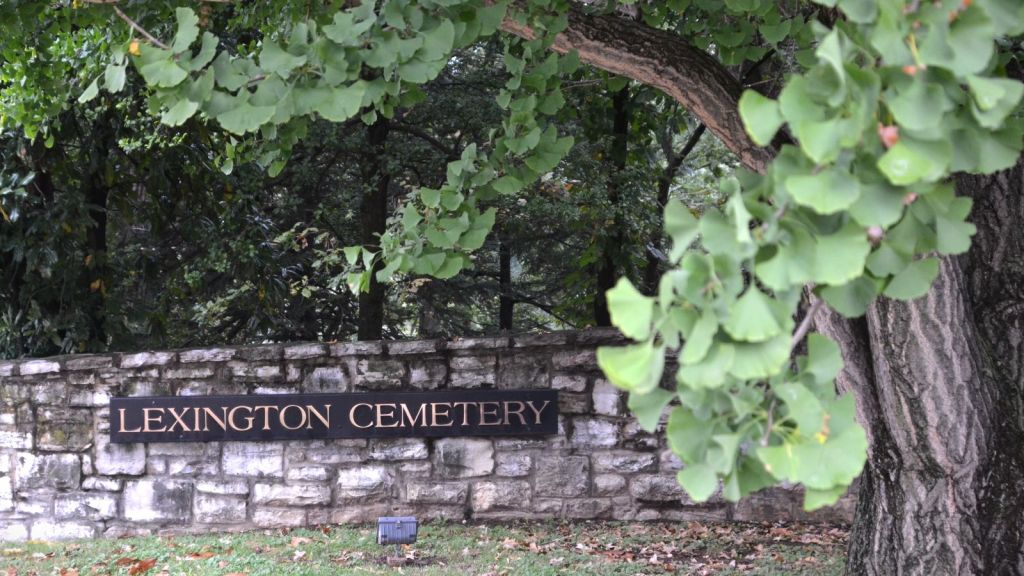
The company bought forty acres known as Boswell’s Woods along what’s now West Main Street and hired Charles S. Bell, a Scottish-trained horticulturist, as its first general manager. Bell had studied the ideas behind Mount Auburn Cemetery outside Boston and John Claudius Loudon’s writing on cemetery design, and he set out to lay Lexington’s grounds the same way: curving roads instead of a grid, hedges enclosing family plots, a working nursery on-site. The cemetery opened for burials on October 2, 1849, and has since grown from forty acres to a hundred and seventy, with an arboretum’s worth of trees, some planted in Bell’s own lifetime, still standing.
The Great Compromiser Comes Home
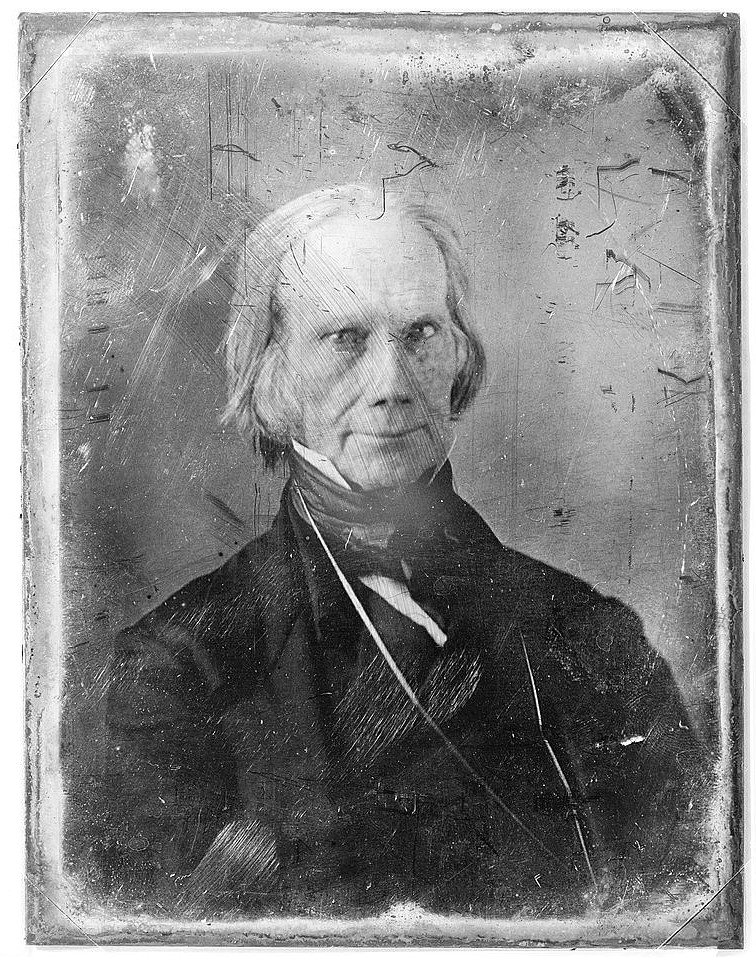
Henry Clay didn’t live to see much of what Bell built. Clay died in Washington in 1852, and when his body returned to Lexington, more than 30,000 people are said to have turned out, a crowd that would have dwarfed the city’s population at the time. He’d already accepted a burial plot from cemetery founder John Lutz the year before, a small courtesy Lutz extended in thanks for his work laying out the grounds. Five years after Clay’s death, the cemetery broke ground on the 120-foot monument the marker describes, designed by architect Thomas Lewinski and finished in 1861 at a cost of over $55,000. It remains the tallest thing on the property, visible from well outside the cemetery walls, and it set the tone for the kind of memorial landscape the rest of the grounds would grow into.
Whose “Noted Men”
The marker’s second half is a list: James Lane Allen, a Lexington-born novelist; John C. Breckinridge, the youngest vice president in U.S. history and later a Confederate general; and John Hunt Morgan, the Confederate cavalry raider known for his 1863 dash across Ohio and Indiana. What the marker doesn’t say is that Breckinridge served as the Confederacy’s last Secretary of War, or that Morgan’s raids were, by his own men’s accounts, as much about plunder and terror as strategy. Both men are buried in family plots here alongside more than five hundred other Confederate dead and eleven hundred Union veterans, a fact the marker presents as simple, tidy coexistence: “both Confederate and Union soldiers are buried in this cemetery.”
That coexistence got more complicated in 2018. Statues of Morgan and Breckinridge had stood on the lawn of the old Fayette County Courthouse downtown since 1911 and 1887, respectively, both funded in part by the United Daughters of the Confederacy. After the 2017 white-nationalist rally in Charlottesville, Lexington’s mayor moved to take them down, and that October the city removed them to storage. The following July, using privately raised funds, the city quietly relocated both statues to Lexington Cemetery, near the family plots where Morgan and Breckinridge are actually buried. It was framed at the time as relocation rather than erasure, moving monuments from a public square to a private cemetery where visitors could choose whether to seek them out. The marker predates all of this by four decades, so its calm list of “noted men” reads very differently today than it did in 1976.
A Cemetery for Some
The marker is silent on a more basic point: for most of the nineteenth century, Lexington Cemetery was, in practice, a white cemetery. Enslaved people and free Black Lexingtonians were not part of the “natural landscape park” the marker describes, and when Black community leaders wanted a dignified burial ground of their own, they had to build one. In 1852, a group of Lexington’s Black residents formed the Union Benevolent Society No. 2 “to take care of the sick, bury the dead, and perform other deeds of charity.” In 1869, the society purchased four acres in northeast Lexington that became African Cemetery No. 2, now the resting place of more than a hundred and fifty U.S. Colored Troops veterans, Kentucky Derby–winning jockey Oliver Lewis, and generations of the city’s Black civic leaders. A second Black cemetery, Cove Haven, followed in 1907, founded by fourteen formerly enslaved men. Neither was an accident of preference; both existed because Lexington’s oldest and most prominent burial ground wasn’t built with Black Lexingtonians in mind.
Who’s Buried Here
Lexington Cemetery holds more than 64,000 burials, and its roster reads like a cross-section of the city’s public life for a century and a half, U.S. vice presidents and Confederate generals, suffragists and surgeons, a novelist named right in this marker’s own inscription. Two companion pieces dig into that roster: Statesmen, Soldiers, and Lexington Fame covers the politicians, generals, and public men whose names dominate the cemetery’s own tours and literature, while Reformers, Firsts, and the Cemetery’s Silences turns to the women who built parallel legacies here, in medicine, suffrage, law, and engineering, and to the one enslaved woman whose grave the cemetery still describes in the language of her enslavers.
What the Marker Doesn’t Say
Read in 1976, the marker’s language is almost aggressively neutral: a “natural landscape park,” a monument, a list of “noted men.” What it leaves out is everything that made those men noted, and everything the cemetery’s own history reveals about who that park was built to include. It doesn’t mention that Breckinridge and Morgan fought to preserve slavery, or that their statues arrived at the cemetery only after a public reckoning forced the city’s hand, or that the same era that built Lexington Cemetery’s ponds and hedgerows left Black Lexingtonians to found their own burial grounds a few miles away. None of that makes the cemetery less beautiful, or Bell’s landscaping less genuinely ambitious. But a marker that lists Henry Clay’s monument and two Confederate generals as simple points of civic pride, without a word about what any of it cost or who it excluded, is telling only part of Lexington’s story.
Sources consulted: Kentucky Historical Society marker database; Historical Marker Database (HMDB); Lexington Cemetery’s official history; The Cultural Landscape Foundation; ExploreKYHistory; Notable Kentucky African Americans Database; Wikipedia; contemporary news coverage of the 2017–2018 Confederate statue relocation.



I’m eager to hear what you think