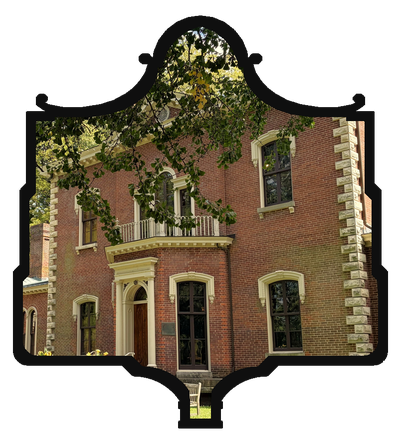
A companion to Marker No. 1033: Eastern State Hospital
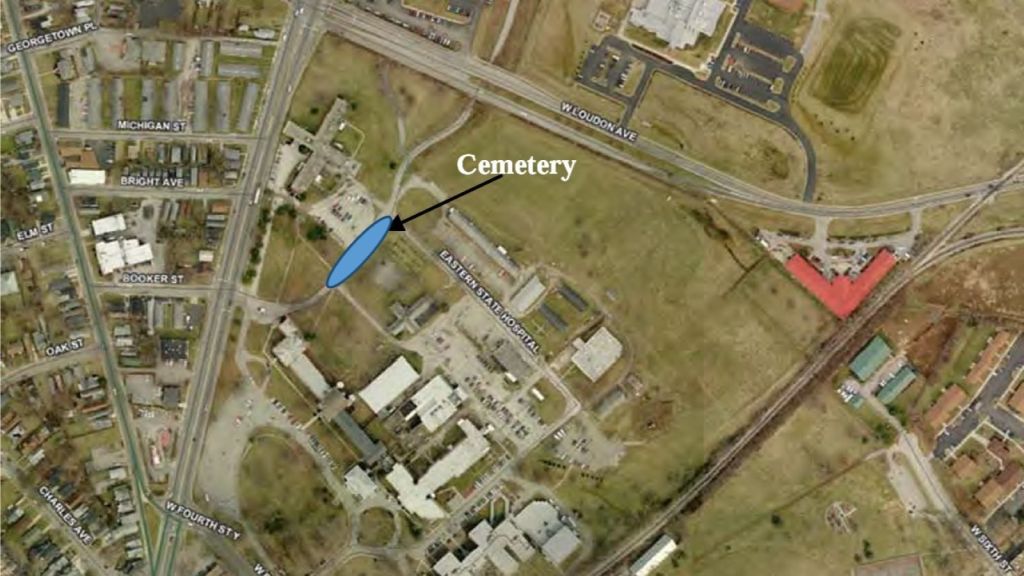
In January 2011, a construction crew preparing the old Eastern State Hospital campus for a new community college building found what a backhoe operator had first stumbled onto back in 2005: unmarked graves, far more of them than anyone expected, quietly holding at least 186 people that nobody currently living had ever been told to look for.
It wasn’t the first time this had happened at Eastern State, and this is worth saying plainly before anything else, it wasn’t the last piece of ground on this property still holding the dead. What follows isn’t really a story about an archaeological dig. It’s a story about who ends up forgotten, and how an institution manages to forget the same people twice over two centuries. The historical marker down the road only gestures at this.
A Cemetery Built to Disappear
The people buried in this particular plot died between 1839 and 1861, according to the coffin hardware, the porcelain buttons, and the deed records archaeologists cross-referenced afterward. The land itself had been added to the hospital’s original ten acres in 1839, and the cemetery sat along its northwestern edge, roughly where the Infirmary and Nurses’ Dormitory would later stand, just off what was then Newtown Pike.
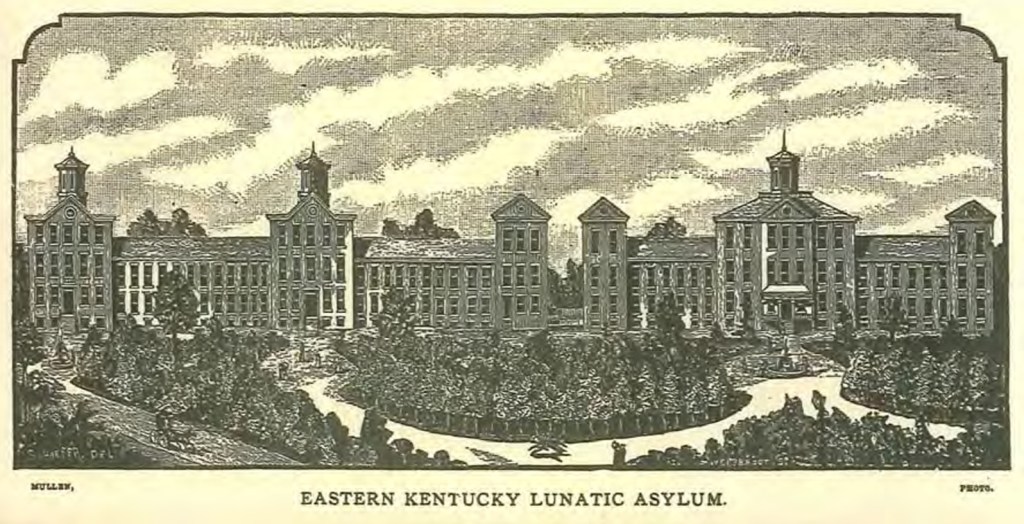
Then, in 1861, the hospital repurposed that same ground as its “pleasure garden,” part of an ambitious new landscape the Commissioners had been “laying out and ornamenting” for the better part of two decades. An 1829 description of the grounds talks of little more than a spring, a kitchen garden, and a common rail fence; by 1861, a map of the same property shows circular carriage drives, groves of trees, a flower garden, a fountain, an orchard, and a fish pond. Nineteenth-century psychiatry took the surrounding landscape seriously as part of the cure, their thinking held that scenery itself, walked among daily, could help settle a disturbed mind. Whatever grave markers had existed on this stretch of ground were removed to make way for that theory. The cemetery didn’t fall into neglect by accident; it was landscaped over, on purpose, in the same year its last occupant was buried, by the very institution that had buried them. An 1887 map of the property shows the buildings in careful detail. It does not show a cemetery at all.
That’s not unusual for the era, and it’s worth saying so out right rather than treating it as a unique cruelty: nineteenth-century Americans generally didn’t extend reverence to pauper burial grounds that later generations expect of cemeteries. Family plots got relocated or paved over across antebellum America once the families who remembered them moved on or died out. What made Eastern State’s cemetery especially easy to erase was that most of the people in it had no family nearby to object in the first place, patients sent from counties throughout Kentucky, many without means, some without anyone left to ask where they’d gone.
Who Was Buried Here
The people in this cemetery were, by and large, the ones Kentucky society had already stopped noticing. Patients came from counties across the state, sent to Lexington once families or local communities could no longer manage them at home, the hospital’s own founding purpose, as its supporters described it in 1816, was to care for the “poor, disabled, and infirm” who had no “rich relatives” to look after them. Wealthier families, when they had a member who needed care, generally paid to keep them at home or arranged private board elsewhere. The people who ended up as patients at a state asylum, and later in its cemetery, were disproportionately those without money, connections, or nearby family to advocate for them, a pattern that shaped who ended up forgotten here just as much as anything about their illnesses did.
So, indigence is why so many stayed unclaimed at death. A patient with family nearby and the means to do so could have the body sent home for burial. Patients without either option, and Eastern State’s population skewed heavily toward exactly that group, were buried on the grounds, by the institution, with no one keeping track of whose grave was whose beyond a number in a ledger.
Treatment itself, in the hospital’s first decades, was closer to confinement than care. Early psychiatric medicine, following the theories of the era, treated mental illness as either a “moral” failing rooted in ungoverned passions or a physical disease of the brain, and its remedies ran the gamut from bloodletting and purgatives to prolonged confinement in darkness and physical restraint devices that would be considered outright torture today. “Moral treatment,” the more humane reform movement the hospital eventually adopted under Dr. John Rowan Allen in 1844, represented a genuine improvement, built on structure, routine, and the idea that patients might actually recover rather than simply be confined. But reform arrived unevenly and slowly, and it coexisted for decades with the older, harsher practices it was supposed to replace.
Labor was central to how the hospital practiced treatment, for better and for worse. Patients were expected to work the hospital’s farm, its kitchens, and its grounds as a matter of policy, it was considered therapeutic by the doctors of the era, but also, not incidentally, a source of free labor for a chronically underfunded institution. When the hospital needed a major building expansion in 1847, it was patients who dug the foundation, quarried the stone, and made the bricks by hand. The Directors called the arrangement beneficial to patient health and regretted only that there wasn’t more work to keep everyone occupied.
Whatever their circumstances in life, the people buried here were laid to rest with the ordinary customs of their time, dressed in shirts and dresses, arms positioned according to family or religious tradition, in wooden coffins like anyone else in a mid-nineteenth-century Kentucky cemetery. It’s worth holding onto that detail, because it’s easy to picture a pauper’s burial ground as something makeshift or careless. It wasn’t. The neglect here came later, and it came from the institution’s living staff, not from whoever dug these particular graves.
That neglect showed up starkly during epidemics. Cholera outbreaks in 1849, 1850, and possibly 1856 killed almost 200 hospital patients in an eighteen-month stretch, and multiple burials sharing a single grave cluster heavily around those years, a hospital racing to bury its dead before the next wave hit had every practical reason to dig one large grave instead of several small ones. Cholera hit poor and institutionalized populations everywhere it traveled far harder than wealthier ones, for a simple and telling reason: wealthier households could flee an outbreak or afford cleaner water. A patient confined to a hospital ward, with no say in his or her own care, could do neither.
A Segregated Institution, Even in Death
The cemetery’s active years, 1839 to 1861, sit almost entirely before Eastern State began systematically admitting large numbers of Black patients, a shift that followed an 1869 legislative decision to assign the state’s entire Black patient population to the Lexington asylum rather than splitting it with the newer hospital in Hopkinsville. What followed is a matter of public record, and not a flattering one: a segregated ward building, described by the hospital’s own superintendents across three decades, in 1888, 1896, 1898, and again in 1913, as too small, poorly ventilated, and in one superintendent’s own words, “totally unfit.” A dedicated, adequate building for Black patients wasn’t constructed until 1951.
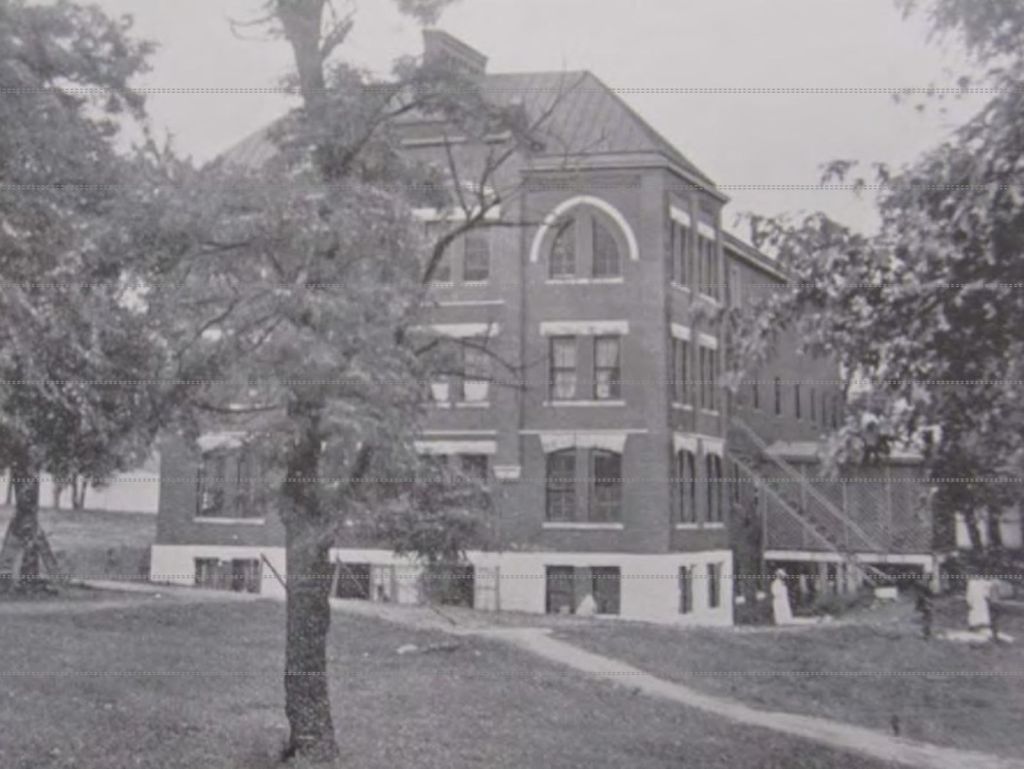
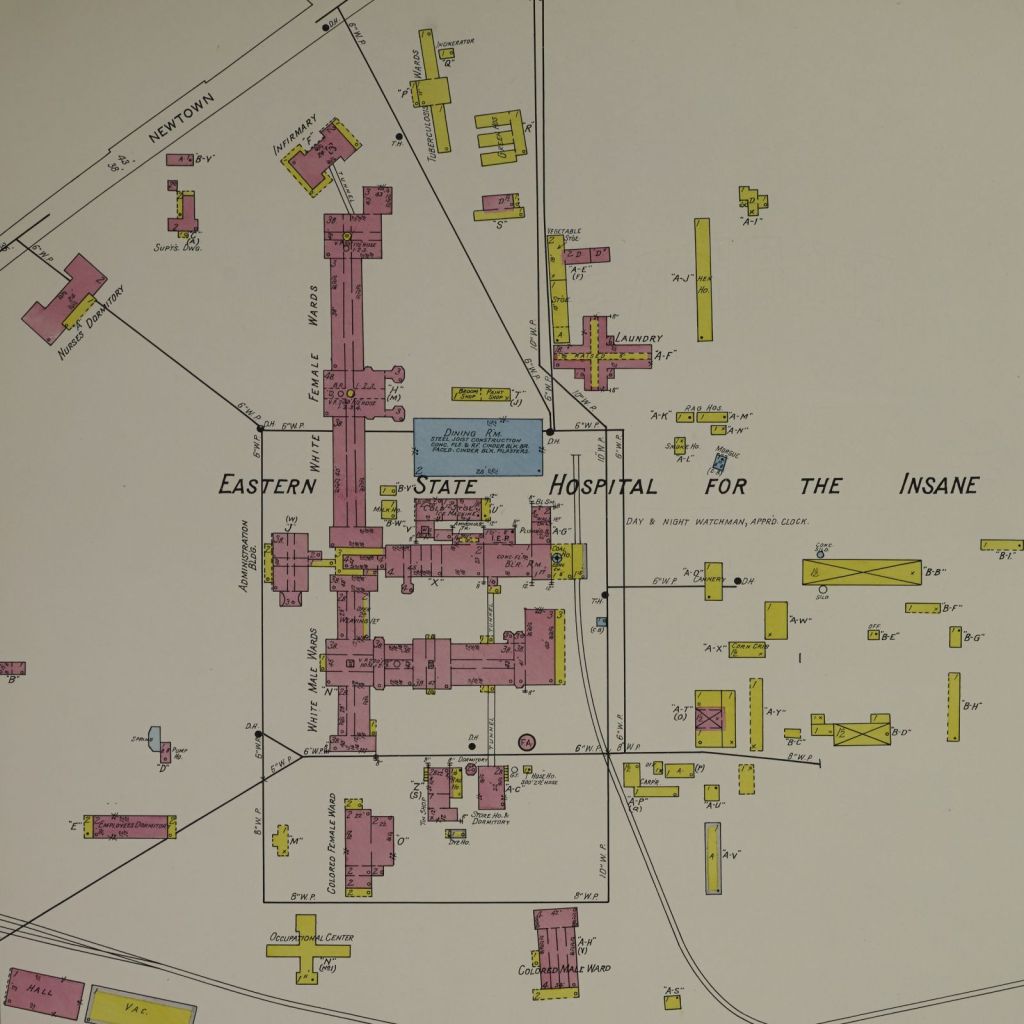
The 1934 Sanborn fire insurance map of the campus still shows the physical shape of that segregation in a plain outline, a “Colored Female Ward” and “Colored Male Ward” standing apart from the main hospital buildings, just as the excavation site sat apart, forgotten, on the same grounds. Whether patients buried in the 1839–1861 cemetery were segregated by race the same way the later wards clearly were is one of the open questions the archaeological report doesn’t fully resolve, since Black admissions were still relatively rare in the cemetery’s active decades, worth noting as a gap in the record rather than glossing over it.
The Pattern Repeats
Here’s the part that the historical marker down the road doesn’t have room for, and honestly, most casual accounts of this cemetery get flattened, too: there wasn’t one lost cemetery at Eastern State. There were at least two.
By 1861, the same year the antebellum cemetery became a pleasure garden, the hospital had already established a second burial ground, on newly acquired land some distance from the main complex. That cemetery served the hospital for over a century, into the twentieth century. It, too, eventually vanished from institutional memory the same way its predecessor had. In 1984, construction crews building Loudon Avenue through the property discovered unmarked graves there as well, this time, more than 4,000 of them. Those remains were disinterred and reburied behind what’s now the Hope Center.
That 4,000-plus figure is worth considering, because it’s the number most often repeated online as the total for “the Eastern State Hospital cemetery,” sometimes stretched further, to a commonly cited range of 4,000 to 6,000, occasionally as high as 10,000, covering the roughly two centuries the hospital operated on this site. It’s a real number, but it belongs to the second, later cemetery, not the one carefully excavated between 2005 and 2011. Conflating the two, treating 186 documented, individually analyzed antebellum burials as though they were the same event as 4,000 twentieth-century reburials, collapses two distinct histories, a century apart, into one vaguer and less accurate story. The truth is less tidy and more damning: this wasn’t a single unfortunate incident. It was a pattern that repeated across a hundred and forty-five years, at the same institution, on the same acreage, each time seemingly surprising the people who worked there.
What’s Still There
Only about two-thirds of the antebellum cemetery was excavated before Bluegrass Community and Technical College took control of the property in 2011. Archaeologists estimate the remaining third, extending north, toward what’s now the college campus, likely holds another 75 to 100 graves. For now, that section has been left undisturbed and designated as green space. Unless the campus expands further, no one currently plans to dig it up. The 186 sets of remains that were recovered were reinterred in 2012, in the northwestern corner of the BCTC campus, a marked, if modest, act of restoration after 150 years of the opposite. Later burials at Eastern State, into the twentieth century, were marked by a still bleaker system: a concrete-filled tin can, stamped with a grave number, set at the head of each plot. The cans have long since rusted and disintegrated. Whatever numbers they once carried are gone with them.
A Building That Waited, Grounds That Forgot
The main historical marker for Eastern State Hospital tells the story of a building that sat empty for seven years before it ever treated a single patient, a slow, awkward start to what became one of the longest continuously operating psychiatric hospitals in the country. Its first patient, remembered in the record only as a Black woman named Charity, arrived at an institution that would spend the next two centuries alternately reforming itself and failing the people in its care, often at the same time.
The cemetery tells the inverse story of that same institution: not a place that struggled to open, but one that closed quietly, twice, and was built over both times by an institution that simply moved on to the next improvement, the next building, the next generation of staff with no reason to ask what lay under the grass. Two hundred years, two forgotten burial grounds, and as far as anyone currently knows, somewhere between 4,000 and roughly 6,000 people the Commonwealth of Kentucky buried on this property and, for a long time, stopped trying to remember.
Sources consulted: Pollack, David, and Heather Worne, eds., Archaeological Investigations of the Eastern State Hospital Cemetery (1839–1861), Fayette County, Kentucky, Kentucky Archaeological Survey Research Report No. 11 (2014); Kentucky Archaeological Survey, “Eastern State Hospital Cemetery” (archaeology.ky.gov); University of Kentucky College of Arts & Sciences news coverage of the 2011 excavation; Kentucky Historic Institutions (kyhi.org), including the ESH Cemetery Preservation Project; Eastern State Hospital Cemetery Preservation Project (easternstatehospital.wordpress.com).



I’m eager to hear what you think